Quick Takeaways: What You Need to Know
- Shifted from capturing light to expressing emotion and structure.
- Used bold, unnatural colors and thick paint (impasto).
- Paved the way for 20th-century movements like Cubism and Fauvism.
- Centered around iconic figures like Van Gogh, Cézanne, and Gauguin.
Why the Impressionists Weren't Enough
To understand why this movement happened, you have to realize that Impressionism was almost too successful. Artists like Monet were brilliant at catching the way sunlight hit a lily pond, but by the 1880s, some painters felt this approach was too superficial. They felt the focus on the "moment" ignored the permanent structure of things and the inner turmoil of the human experience. They wanted more substance. Instead of just sketching the world, they started distorting it to convey a mood. If a painter felt sadness, they might make the shadows deep purple instead of gray. This was a radical move because it broke the rule that art should mirror reality.
The Architecture of Art: Paul Cézanne
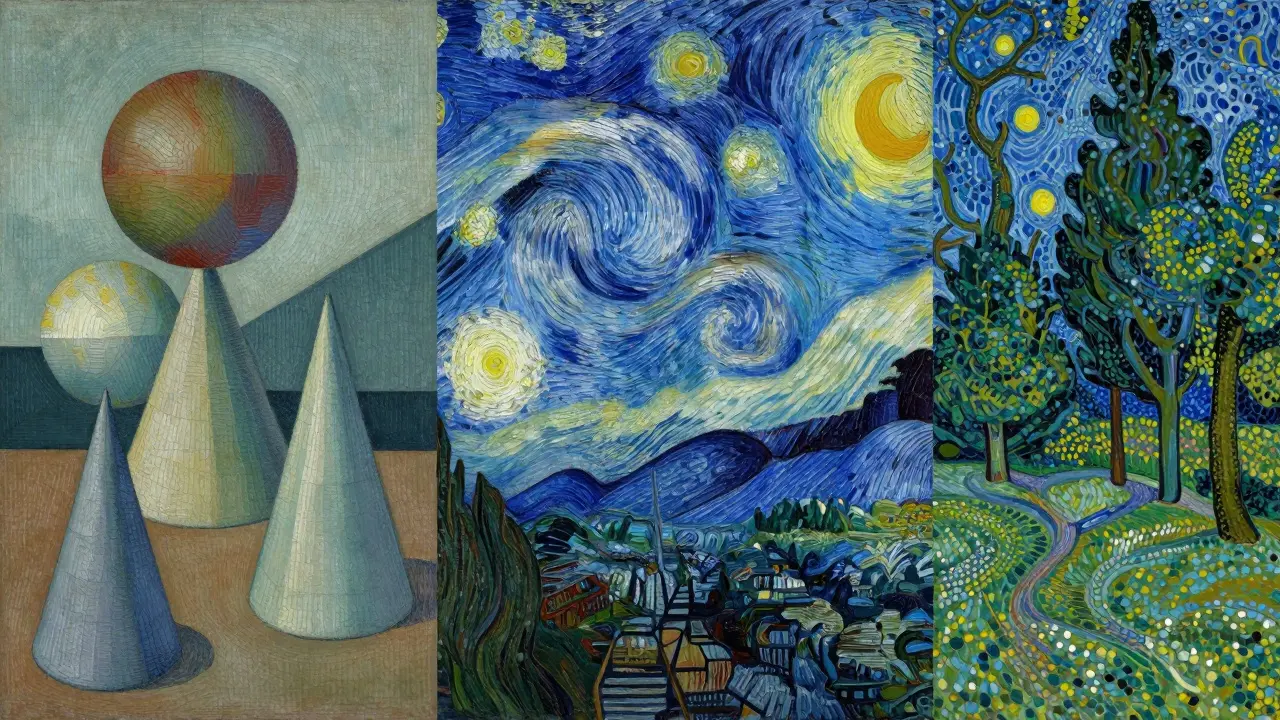
If Post-Impressionism had a structural engineer, it was Paul Cézanne. He didn't care for the "sketchy" look of his predecessors. Instead, he wanted to make Impressionism something "solid and durable, like the art of museums." He looked at nature and saw basic shapes-spheres, cones, and cylinders. When you look at his paintings of Mont Sainte-Victoire, you can see him breaking the landscape into geometric planes. This obsession with structure is why he's often called the father of modern art. He basically laid the groundwork for Cubism, showing that you could look at an object from multiple angles at once on a flat canvas.
Emotion on Canvas: Vincent van Gogh
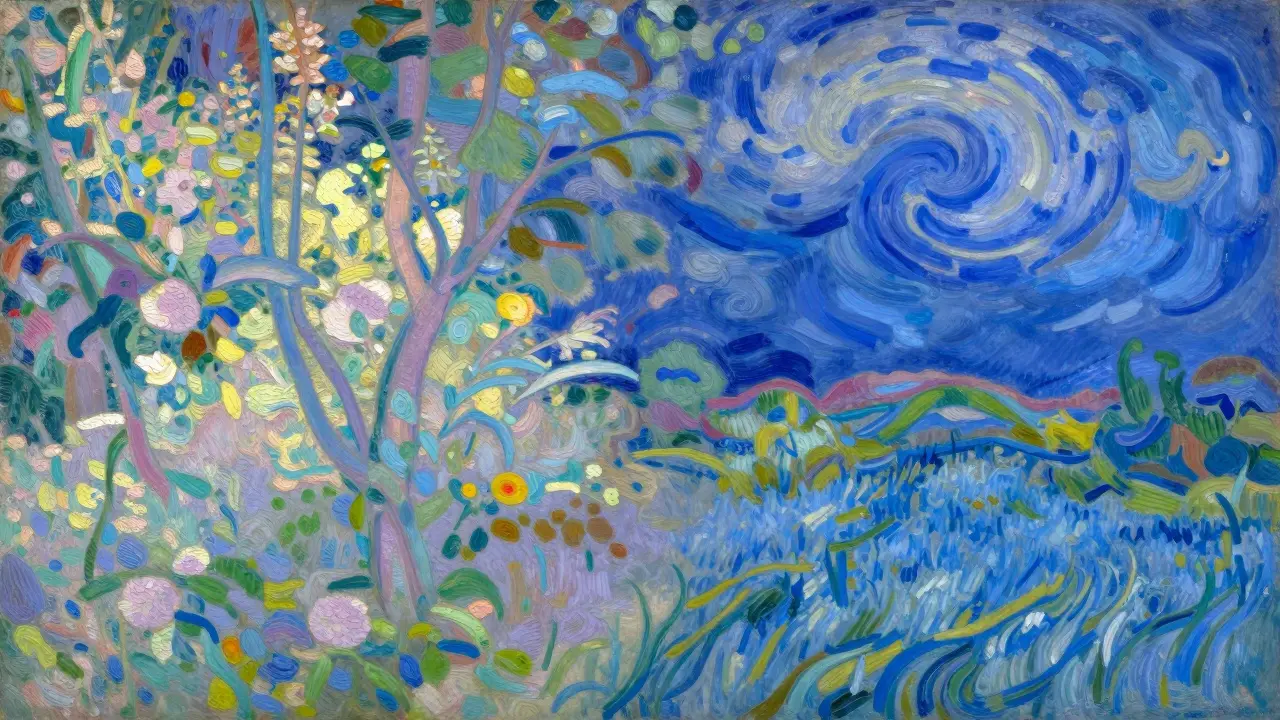
Then you have the man who made color scream: Vincent van Gogh. For him, art was a release valve for his intense emotions. He utilized a technique called impasto, where paint is applied so thick that it stands out from the canvas, creating actual physical texture. In his famous Starry Night, the swirls aren't just decorative; they represent a state of mind. He used complementary colors-like placing a bright yellow star against a deep blue sky-to create a visual vibration that makes the painting feel alive and anxious. He proved that art could be a direct line into a person's psyche, bypassing the need for "realistic" depiction.
The Science of Dots: Pointillism and Georges Seurat
While Van Gogh was all about raw passion, Georges Seurat took a scientific approach. He developed Pointillism, a method where the artist applies tiny, distinct dots of pure color. Instead of mixing paint on a palette, Seurat let the viewer's eye do the mixing. If you stand close to A Sunday Afternoon on the Island of La Grande Jatte, it looks like a chaotic collection of confetti. But step back, and the colors blend into a crisp, clear scene. This was an attempt to bring mathematical precision to the emotional weight of Post-Impressionism, blending the new science of optics with artistic expression.
| Artist | Core Philosophy | Key Technique | Main Influence |
|---|---|---|---|
| Paul Cézanne | Geometric Structure | Planar Construction | Cubism |
| Vincent van Gogh | Emotional Expression | Impasto / Bold Color | Expressionism |
| Georges Seurat | Optical Science | Pointillism | Neo-Impressionism |
| Paul Gauguin | Flat Color Areas | Fauvism |
The Escape to Paradise: Paul Gauguin
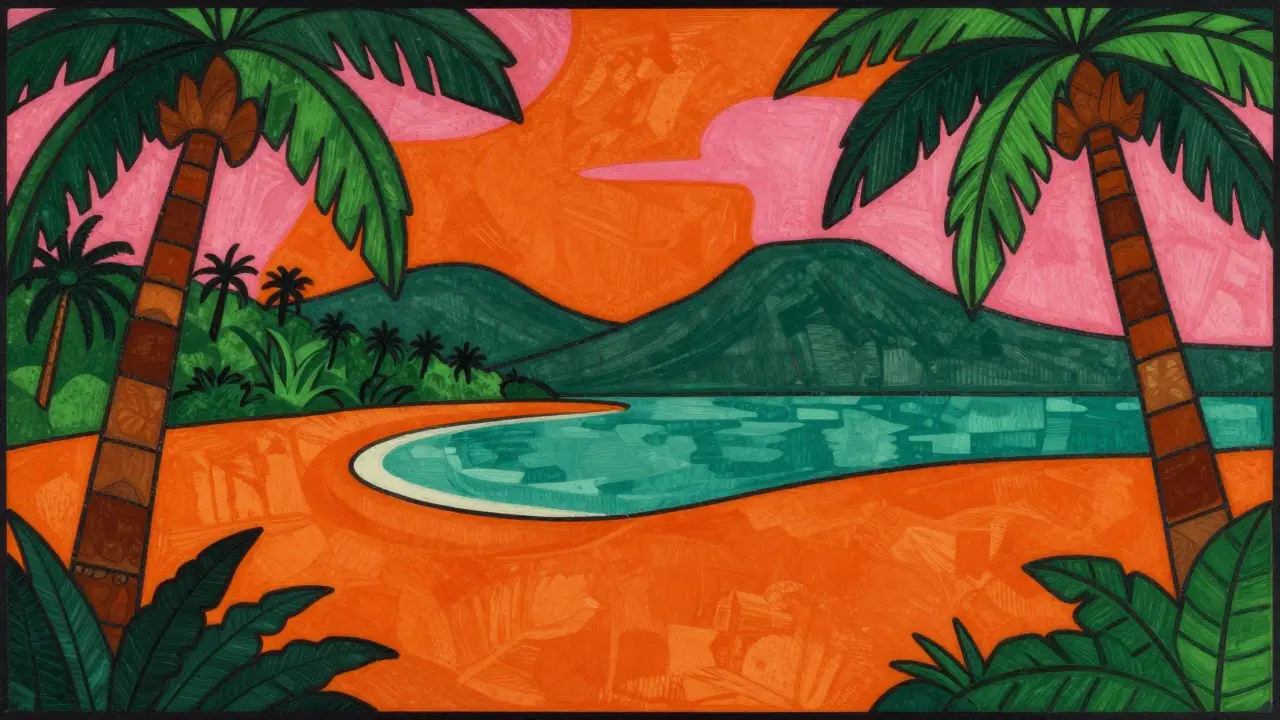
Not every Post-Impressionist was fighting with their internal demons in a studio. Paul Gauguin literally fled Europe for Tahiti to escape what he saw as the corruption of Western civilization. He embraced "primitivism," attempting to capture a purity of spirit he felt was missing in France. Gauguin moved away from three-dimensional shading and instead used large, flat areas of bold color. This style, known as Cloisonnism, looks almost like stained glass. By stripping away the detail, he focused on the symbolic meaning of the image rather than the literal reality, which heavily influenced the later Fauvism movement.
How It Changed the World of Art
Post-Impressionism wasn't just a phase; it was a bridge. Before this era, art was mostly about "what" was being painted. After this, art became about "how" it was being painted and "who" was painting it. By liberating color from its descriptive role-making a face green if it felt right for the mood-these artists broke the chains of traditional representation. Without the structural experiments of Cézanne, we wouldn't have Picasso. Without the emotional intensity of Van Gogh, we wouldn't have the Expressionist movement. They turned the canvas into a mirror for the human mind.
Common Pitfalls When Identifying the Style
People often confuse Impressionism with Post-Impressionism. The easiest way to tell them apart is to look at the edges and the mood. Impressionism is usually soft, hazy, and focused on natural light-think of a sunny garden that feels like a snapshot. Post-Impressionism is more "intentional." You'll see harder edges, more saturated (and often unnatural) colors, and a sense of deliberate composition. If the painting feels like a dream or a memory rather than a photograph, you're likely looking at Post-Impressionism.
Did Post-Impressionists hate Impressionism?
Not exactly. Most of them started as Impressionists or were heavily influenced by them. They didn't hate the style; they just felt it was limited. They wanted to keep the bright colors but add more emotional depth and a firmer structure to the compositions.
Why is Vincent van Gogh so closely linked to this movement?
Van Gogh epitomizes the shift toward subjective expression. His use of color to convey mood rather than reality and his heavy impasto technique became hallmarks of the Post-Impressionist era, bridging the gap to modern Expressionism.
What is Pointillism exactly?
It is a technique pioneered by Georges Seurat where small, distinct dots of color are applied in patterns to form an image. The colors are not mixed on the palette but blend optically in the viewer's eye, creating a more luminous effect.
Where can I see these works today?
The most significant collections are found in the Musée d'Orsay in Paris, the MoMA in New York City, and the Van Gogh Museum in Amsterdam. These institutions house the core works of Cézanne, Van Gogh, and Seurat.
How did this lead to Cubism?
Paul Cézanne's approach of reducing nature to geometric shapes (spheres and cones) taught future artists like Pablo Picasso that a painting doesn't have to follow a single perspective. This "deconstruction" of the image is the fundamental principle of Cubism.