De Stijl didn’t just change painting-it rewrote the rules of how furniture looks, feels, and functions. When a group of Dutch artists and architects gathered in 1917 to push art into a new, radical direction, they weren’t thinking about chairs or tables. But their ideas became the blueprint for everything from sleek office desks to minimalist living rooms today. De Stijl’s clean lines, bold primaries, and rejection of ornament didn’t stay on canvas. They moved into three dimensions-and changed furniture forever.
The Birth of a Movement
De Stijl, meaning "The Style" in Dutch, began as an art journal and evolved into a full-blown philosophy. Founded by Theo van Doesburg in 1917, it included artists like Piet Mondrian and architects like Gerrit Rietveld. Their goal was simple: strip away everything unnecessary. No curves. No decoration. No history. Just pure form, balanced by vertical and horizontal lines, and color reduced to black, white, gray, and the three primaries: red, yellow, and blue.
This wasn’t just aesthetics. It was a belief that art could help rebuild society after the chaos of World War I. They thought if you could create harmony in a painting, you could create harmony in a home, a street, a city. And furniture? That was the most personal space where that harmony lived.
From Canvas to Chair: Rietveld’s Red and Blue Chair
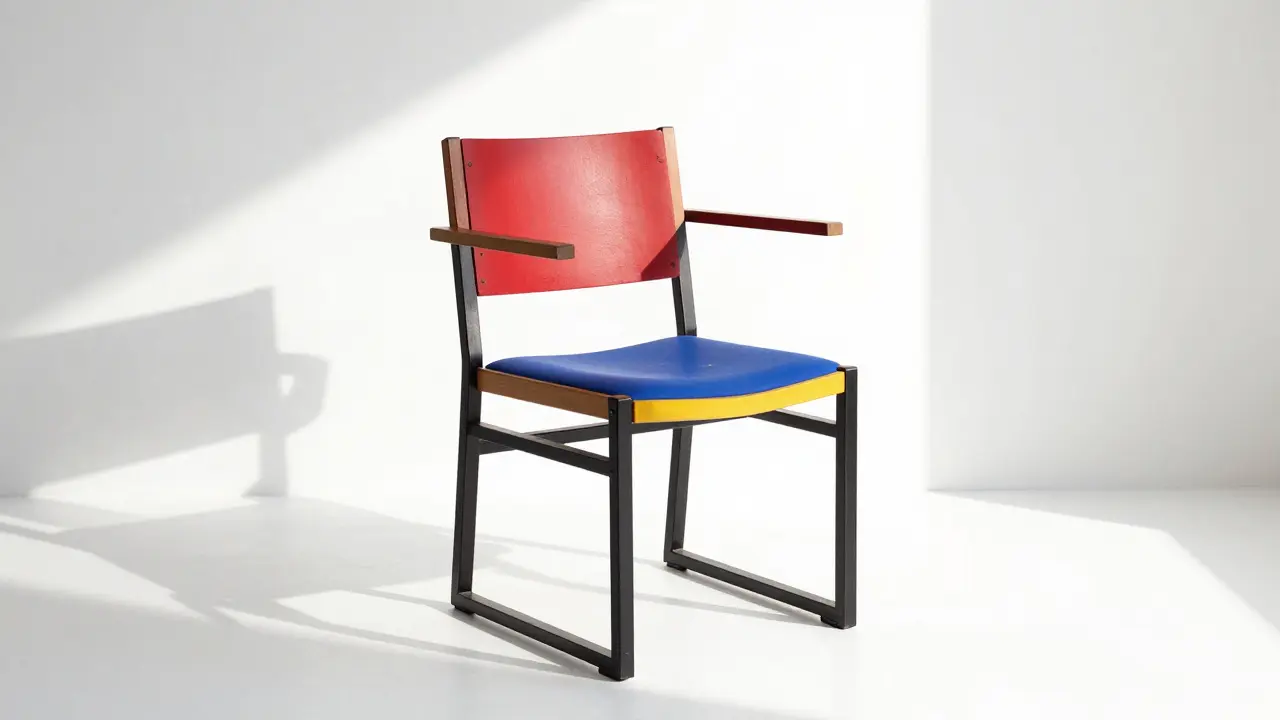
Nothing shows the leap from painting to furniture better than Gerrit Rietveld’s Red and Blue Chair, designed in 1918 and refined by 1923. It looks like a Mondrian painting you could sit on. The frame is made of straight wooden slats, joined at right angles. Each part is separate-no curves, no upholstered cushions at first. The colors? Red for the backrest, blue for the seat, yellow for the ends, black for the structure. White space fills the gaps.
It wasn’t comfortable in the traditional sense. But it didn’t need to be. It was a statement: furniture didn’t have to mimic nature or history. It could be abstract, geometric, and functional all at once. The chair became iconic because it proved that art could be lived in. You didn’t just look at De Stijl-you sat on it.
How De Stijl Changed Furniture Design
Before De Stijl, most furniture was heavy, carved, or ornate. Think Victorian woodwork or Art Deco inlays. De Stijl flipped that. It introduced five core principles that still define modern furniture:
- Geometric simplicity - No curves. Everything is straight lines and right angles.
- Structural honesty - The frame shows how it’s built. Joints aren’t hidden; they’re celebrated.
- Color as form - Paint isn’t decoration. It defines function. A red part isn’t just red-it’s the backrest.
- Modularity - Pieces can be rearranged, stacked, or combined. Think of today’s flat-pack shelves.
- Mass production readiness - Simple shapes mean simpler, cheaper manufacturing.
These ideas didn’t just influence one chair. They became the DNA of 20th-century design. The Barcelona Chair by Mies van der Rohe? It borrows De Stijl’s purity. The Eames plywood chairs? Their clean geometry owes a debt. Even IKEA’s flat-pack system traces back to De Stijl’s belief that good design should be accessible, not just beautiful.
De Stijl and the Bauhaus: A Quiet Collaboration
While De Stijl was happening in the Netherlands, the Bauhaus school in Germany was developing its own modernist vision. Though they were separate movements, they shared the same goals: simplicity, function, and rejecting the past. Rietveld even taught at the Bauhaus briefly. The Bauhaus took De Stijl’s ideas and made them more industrial-using steel tubing, glass, and standardized parts.
But De Stijl kept its artistic soul. Where Bauhaus leaned toward engineering, De Stijl stayed rooted in painting and abstraction. That’s why you’ll see more color in De Stijl furniture. A Bauhaus chair might be black steel. A De Stijl chair might be red, blue, and yellow. One was a machine. The other was a canvas you could sit on.
Why It Still Matters Today
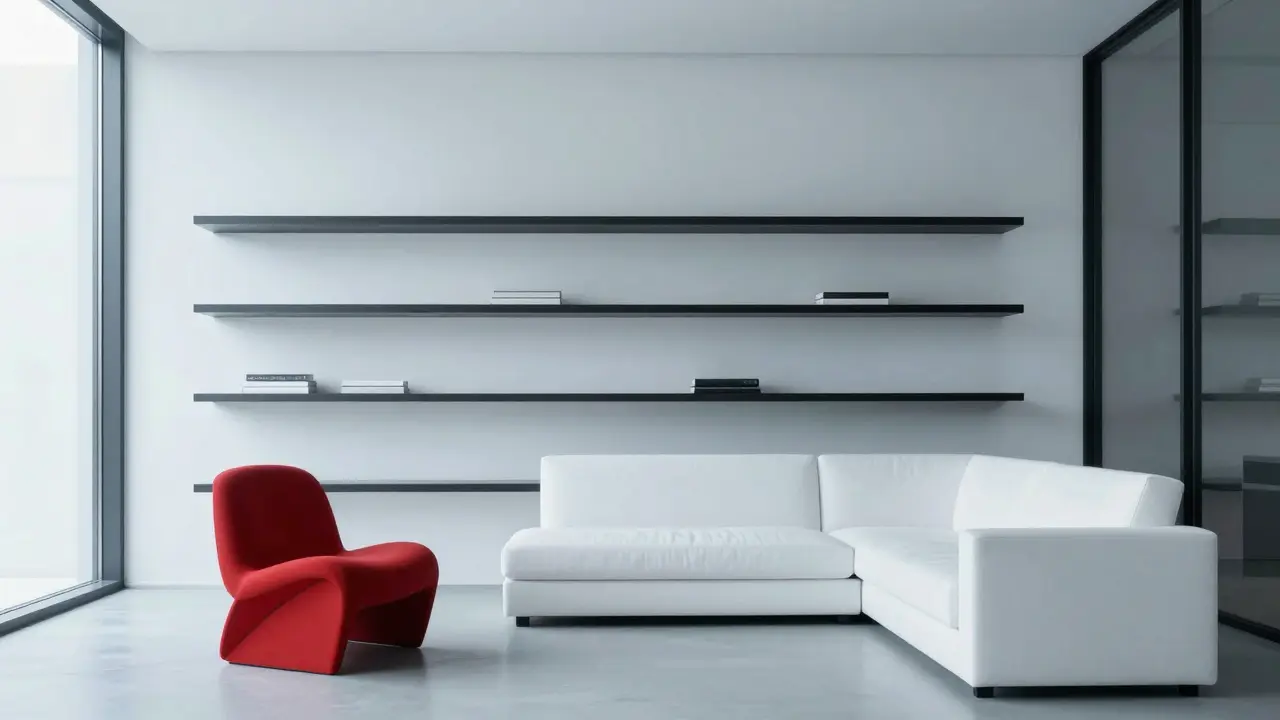
Walk into any modern home, and you’ll find De Stijl’s fingerprints. The floating shelves. The open-plan living spaces. The monochrome sofas with one bold accent cushion. The coffee table with no drawers, no legs, just a flat slab. These aren’t trends-they’re echoes of a movement that asked: What if furniture didn’t need to look like anything else?
Today’s minimalist designers-from Muji to Norman Foster-still use De Stijl’s rules. Even tech companies like Apple borrow its language. The clean lines of an Apple TV stand? That’s De Stijl. The way a Nest thermostat sits flush on a wall? That’s De Stijl.
It’s not about removing decoration for the sake of it. It’s about removing distraction. De Stijl taught us that less isn’t just more-it’s clearer, calmer, and more intentional.
What De Stijl Furniture Isn’t
It’s easy to confuse De Stijl with minimalism or Scandinavian design. But they’re not the same. Scandinavian furniture uses natural wood, soft curves, and warm tones. De Stijl uses painted wood, sharp angles, and primary colors. Scandinavian design feels cozy. De Stijl feels like a manifesto.
Also, De Stijl furniture wasn’t made for comfort first. It was made for ideas. Early versions of the Red and Blue Chair had no padding. People sat on it because it was revolutionary, not because it was soft. That’s why today’s versions often add cushions. But the original frame? That’s still untouched.
Where to See Real De Stijl Furniture
If you want to see the originals, head to the Centraal Museum in Utrecht, Netherlands. That’s where the Red and Blue Chair lives today. The Rietveld Schröder House, also in Utrecht, is a full De Stijl environment-walls, floors, furniture, even the sliding partitions designed as part of one unified composition.
Outside the Netherlands, MoMA in New York and the V&A in London have key pieces in their collections. These aren’t just museum pieces. They’re living examples of how art can become everyday life.
Is De Stijl furniture still made today?
Yes. Original designs like the Red and Blue Chair and the Rietveld Sofa are still produced under license by companies like Verhaeghe and Cassina. These are not reproductions-they’re authorized versions made to the original specifications. You can buy them new, though they’re expensive. Modern brands like &Tradition and HAY also make furniture inspired by De Stijl’s principles, but with updated materials and comfort.
Why did De Stijl use only primary colors?
They believed primary colors were the most fundamental and purest forms of color. Red, yellow, and blue couldn’t be created by mixing others. They represented the essential building blocks of visual harmony, just like horizontal and vertical lines were the building blocks of form. Black and white were used to balance and frame the primaries, creating contrast without distraction.
Did De Stijl influence only furniture, or other design too?
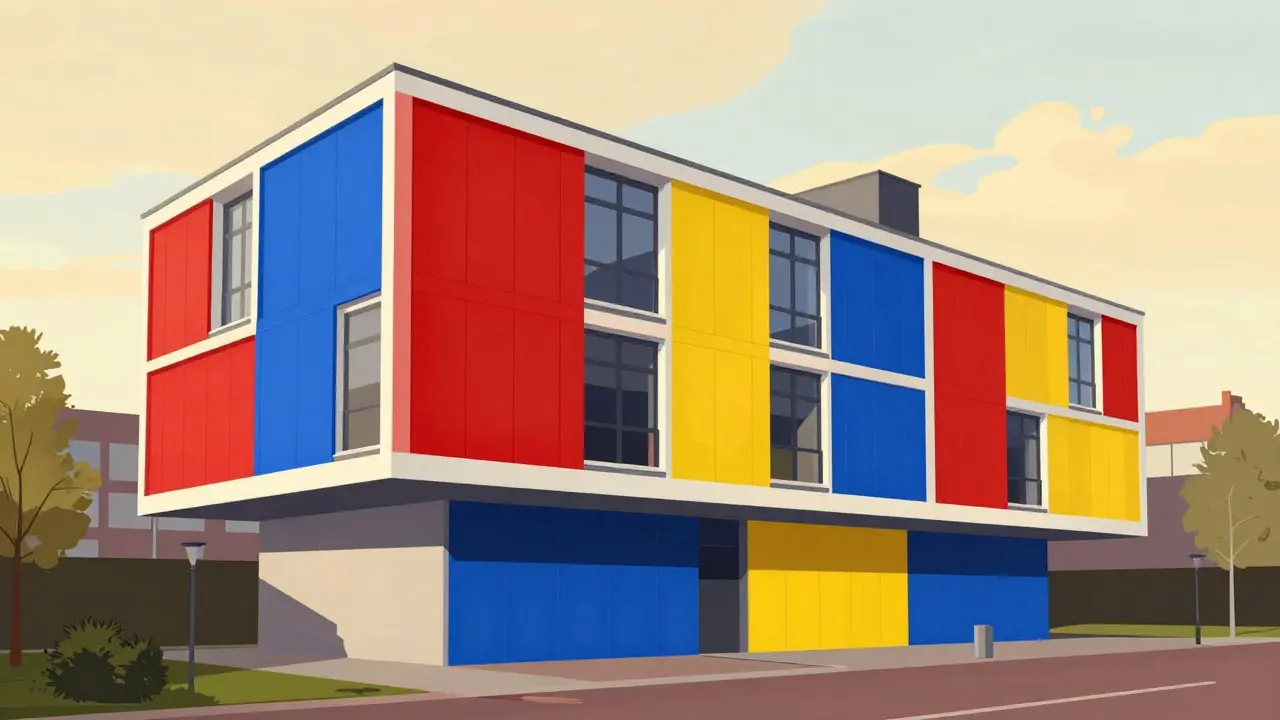
De Stijl influenced everything. It shaped architecture-like the Rietveld Schröder House-with open floor plans and sliding walls. It affected graphic design through its use of grid layouts and sans-serif typography. Even urban planning borrowed its ideas of order and modular spaces. Its reach was total: from posters to lamps to entire buildings.
Can De Stijl style work in a small apartment?
Absolutely. De Stijl’s emphasis on open space, clean lines, and minimal clutter makes it perfect for small areas. A single Red and Blue Chair can be a statement piece. Floating shelves painted in primary colors add structure without taking up floor space. The style avoids heavy, bulky furniture, which helps small rooms feel larger and more open.
Is De Stijl the same as modernism?
De Stijl is one branch of modernism, not the whole tree. Modernism is a broad movement that includes Bauhaus, International Style, and Brutalism. De Stijl is unique because it came from fine art and insisted on color and abstraction as core elements. Other modernist styles often avoided color or focused purely on function. De Stijl made color part of the function.