Quick Takeaways for Art Lovers
- Emotional over Optical: While Impressionists painted what they saw, Post-Impressionists painted how they felt.
- Bold Choices: Expect thick paint (impasto), unnatural colors, and defined edges.
- The Bridge: This movement directly paved the way for 20th-century styles like Cubism and Fauvism.
- Diverse Styles: It includes everything from the tiny dots of Pointillism to the distorted shapes of Gauguin.
Breaking Away from the Light
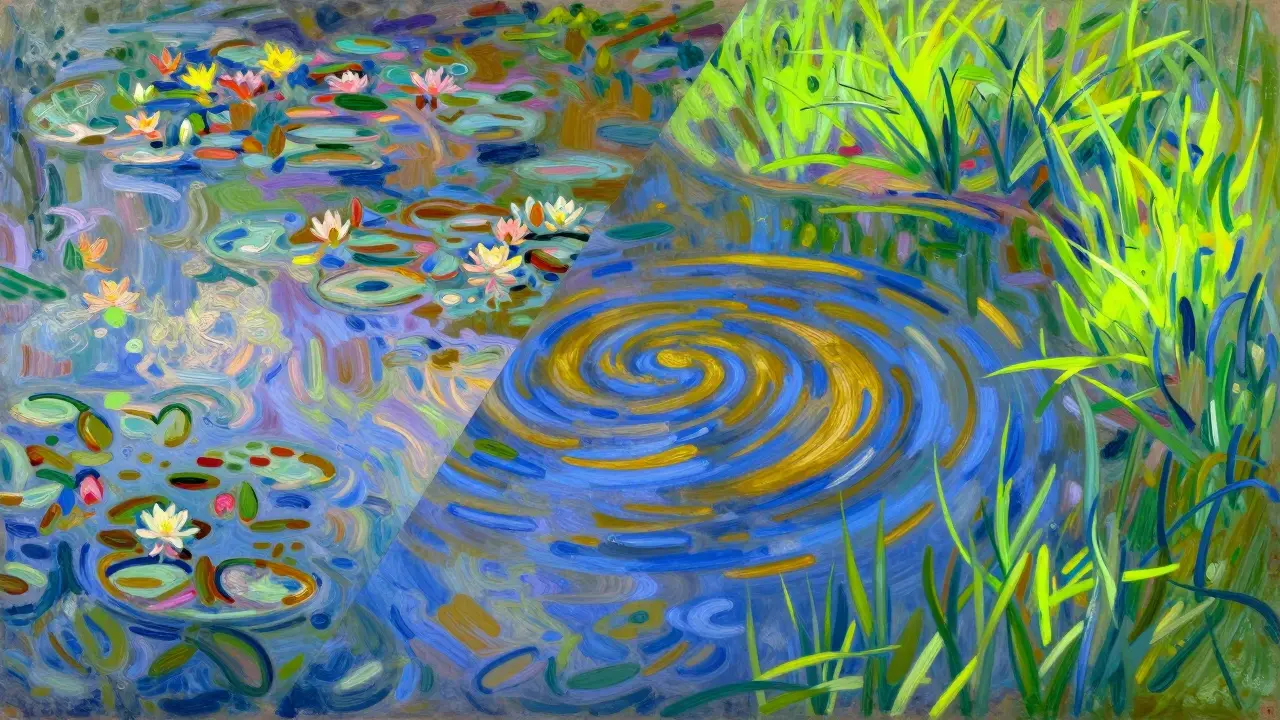
To understand why this movement mattered, you have to understand what they were running away from. Impressionism was all about the "impression"-how light hits a lily pond at 10:00 AM versus 2:00 PM. Artists like Claude Monet were geniuses of optics, but by the 1880s, a new generation felt this approach was too superficial. They felt the art was becoming too focused on the atmosphere and losing the substance of the subject.
The rebels of Post-Impressionism didn't just want to record a scene; they wanted to interpret it. They stopped worrying about whether a tree actually looked green in that specific light and started asking, "What does this tree represent?" This shift changed the goal of painting from observation to expression. If an artist felt grief, they might paint a sky a deep, oppressive violet, even if it was a sunny day in Provence. This was a radical departure that essentially gave artists permission to lie with color to tell a deeper truth.
The Heavy Hitters of the Movement
Post-Impressionism wasn't a unified club with a manifesto. It was more like a group of eccentric geniuses working in different directions. Let's look at the three biggest pillars.
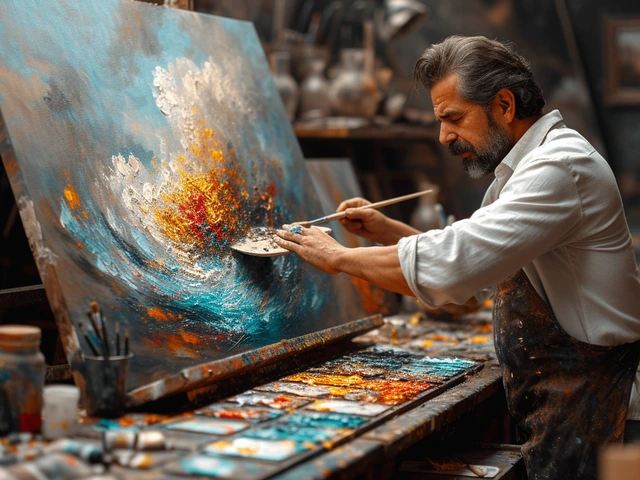
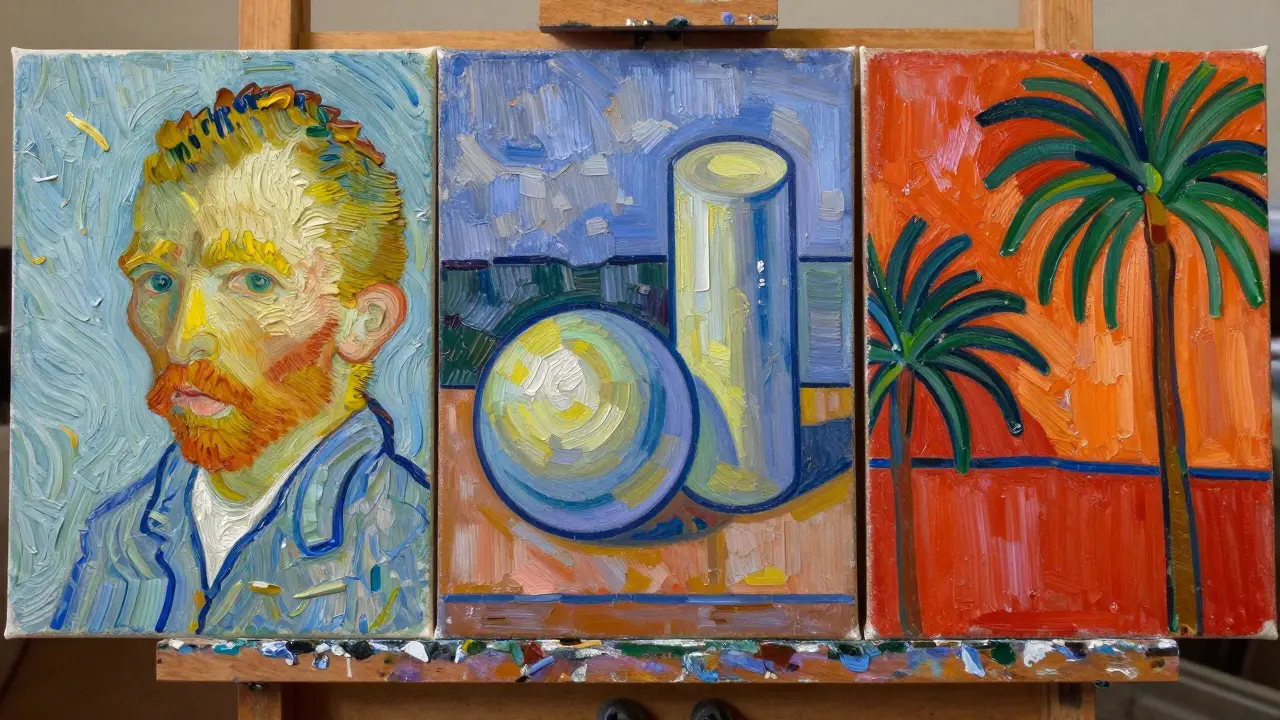
Vincent van Gogh is perhaps the most famous face of the era. He took the bright palette of the Impressionists and cranked the volume up to eleven. His technique involved impasto, which is the process of applying paint so thick that it stands off the canvas, creating physical texture. When you look at "The Starry Night," you aren't just seeing a night sky; you're seeing the rhythmic, swirling energy of his mental state. His work proves that color can function as a psychological tool.
Then there is Paul Cézanne, often called the father of modern art. While Van Gogh focused on emotion, Cézanne focused on structure. He famously wanted to "make of Impressionism something solid and durable, like the art of the museums." He stopped seeing nature as a series of snapshots and started seeing it as a collection of geometric shapes-cylinders, spheres, and cones. By breaking down a landscape into these basic forms, he laid the groundwork for everything that would eventually become Cubism.
Finally, we have Paul Gauguin, who sought a "primitive" purity. He left the civilized streets of Paris for Tahiti, using flat areas of bold, unnatural color and heavy outlines. His work moved art further away from realism and closer to symbolism, where a painting served as a metaphor for spiritual or existential longing.
| Artist | Primary Focus | Key Technique | Legacy Impact |
|---|---|---|---|
| Van Gogh | Emotional Intensity | Impasto/Swirls | Expressionism |
| Cézanne | Geometric Structure | Constructive Strokes | Cubism |
| Gauguin | Symbolism/Primitivism | Cloisonnism (Flat Color) | Modern Fauvism |
| Seurat | Optical Science | Pointillism | Color Theory |
The Science of the Dot: Pointillism
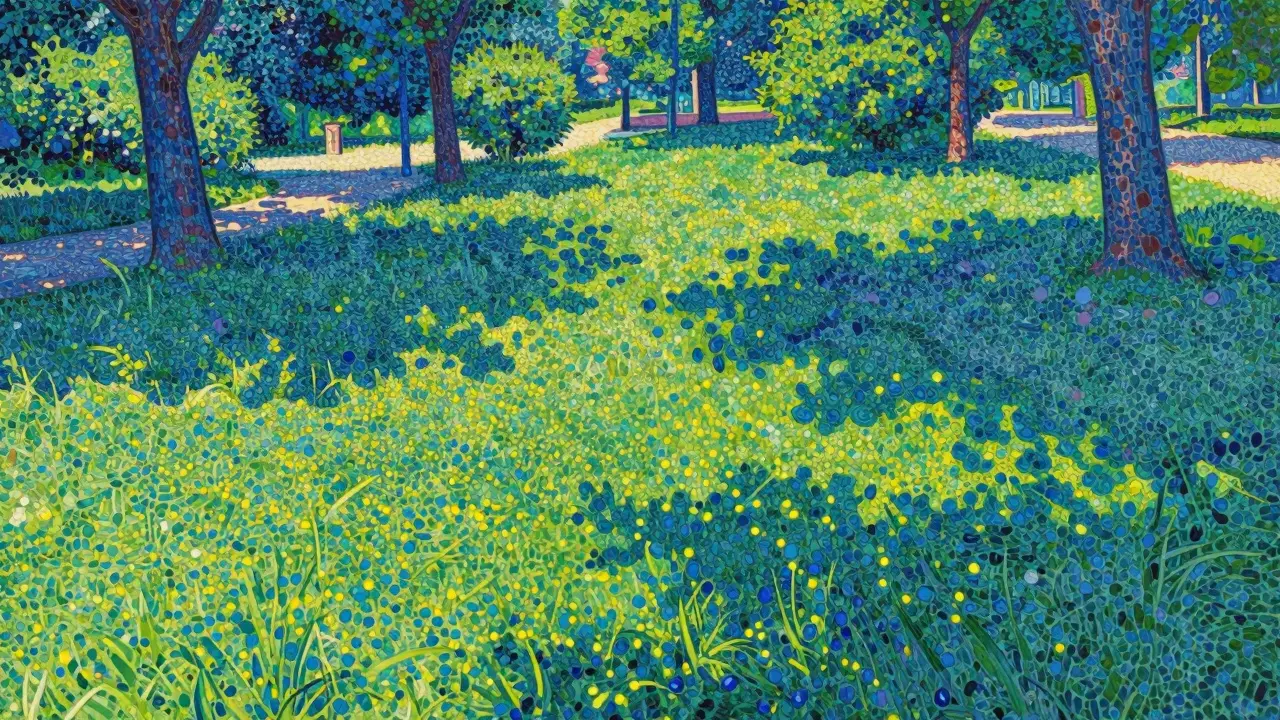
Not every Post-Impressionist was painting from the heart; some were painting from a textbook. Georges Seurat approached the canvas like a scientist. He developed Pointillism, a technique where small, distinct dots of pure color are applied in patterns to form an image. Instead of mixing blue and yellow paint on a palette to make green, Seurat placed a blue dot next to a yellow dot.
Why do this? Because of a phenomenon called optical mixing. When you stand back from the canvas, your eye does the mixing for the artist. This results in a luminosity and a shimmering quality that traditional blending can't achieve. His masterpiece, "A Sunday Afternoon on the Island of La Grande Jatte," took years to complete because of the sheer precision required. It turned the act of painting into a mathematical exercise in color theory, proving that art could be both calculated and beautiful.
Why Does it Matter Today?
If you enjoy the abstract art in a modern gallery or the stylized visuals of a Pixar movie, you're seeing the ghost of Post-Impressionism. Before this era, the "success" of a painting was often judged by how accurately it mirrored reality. These artists broke that contract. They decided that the artist's internal vision was more important than the external world.
This liberation allowed for the rise of Fauvism, where artists like Henri Matisse used colors that were completely divorced from reality (like a green stripe down a woman's face) just to create a mood. It also led to the psychological depth of Expressionism. Without the bridge provided by the Post-Impressionists, the jump from the realistic portraits of the Renaissance to the fragmented faces of Pablo Picasso would have been too steep for the public to handle.
How to Spot a Post-Impressionist Work
Next time you're at a museum, look for these specific markers to tell if you're looking at a Post-Impressionist piece rather than a standard Impressionist one:
- Defined Outlines: Impressionists usually avoided hard lines to mimic how light blurs edges. Post-Impressionists often brought back the outline to give shapes a sense of permanence.
- Saturated Color: If the colors look "too bright" or deliberately "wrong" for the subject, it's likely a move toward emotional expression.
- Distorted Perspectives: Look for tilting floors or strangely proportioned rooms. This was a deliberate choice to emphasize a feeling rather than a perfect architectural draft.
- Visible Brushwork: While both movements showed brushstrokes, Post-Impressionists used them more aggressively-think of the rhythmic pulses in a Van Gogh sky.
Is Post-Impressionism a single style?
No, it's more of an umbrella term. It describes a diverse group of artists who all shared a common desire to move beyond the limitations of Impressionism. This is why you'll find the scientific precision of Seurat in the same category as the raw, emotional chaos of Van Gogh.
What is the difference between Impressionism and Post-Impressionism?
The biggest difference is the goal. Impressionists wanted to capture the immediate, visual effect of light on a scene (optical truth). Post-Impressionists wanted to capture the deeper meaning, emotion, or structural essence of the subject (emotional or conceptual truth).
Why is Paul Cézanne called the father of modern art?
Cézanne stopped trying to paint the world as a flat image and started treating it as a series of 3D volumes. His focus on geometric simplification and multiple perspectives directly influenced the creation of Cubism by artists like Pablo Picasso.
What is the 'impasto' technique mentioned in the article?
Impasto is when paint is applied very thickly to the canvas, often without mixing it with a medium. This creates a physical texture that catches the light and gives the painting a sculptural quality, which Van Gogh used to convey intensity.
Did these artists get recognized in their own time?
Mostly, no. Many were viewed as eccentrics or failures. Van Gogh, for instance, famously sold very few paintings during his life. Their work was too radical for the traditional art salons of the time, only gaining massive popularity after their deaths.