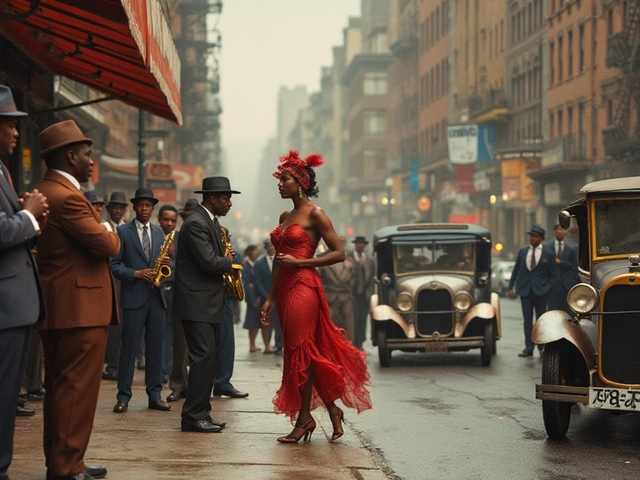
The Harlem Renaissance wasn’t just a moment in history - it was a roar. Between the 1910s and mid-1930s, Black artists, writers, musicians, and thinkers gathered in Harlem, New York, and turned a neighborhood into a beacon of creativity, pride, and resistance. This wasn’t a quiet cultural shift. It was a full-blown revolution in how Black identity was seen, expressed, and claimed - by Black people themselves.
What Exactly Was the Harlem Renaissance?
The Harlem Renaissance was a flowering of African American culture centered in Harlem, but its influence spread across the country and even overseas. It wasn’t organized by a single group or movement. Instead, it grew from the energy of hundreds of individuals - poets, painters, jazz musicians, scholars - who refused to let society define them. They created their own narratives, their own beauty, their own truth.
Millions of Black Americans had moved north during the Great Migration, escaping Jim Crow laws and seeking work in industrial cities. Harlem became a magnet. By 1925, over 200,000 Black residents lived there, making it the largest urban Black community in the U.S. But it wasn’t just about population. It was about possibility. In Harlem, Black people could live without constant fear, open their own businesses, publish their own books, and play music that shook the foundations of American culture.
Art That Refused to Be Invisible
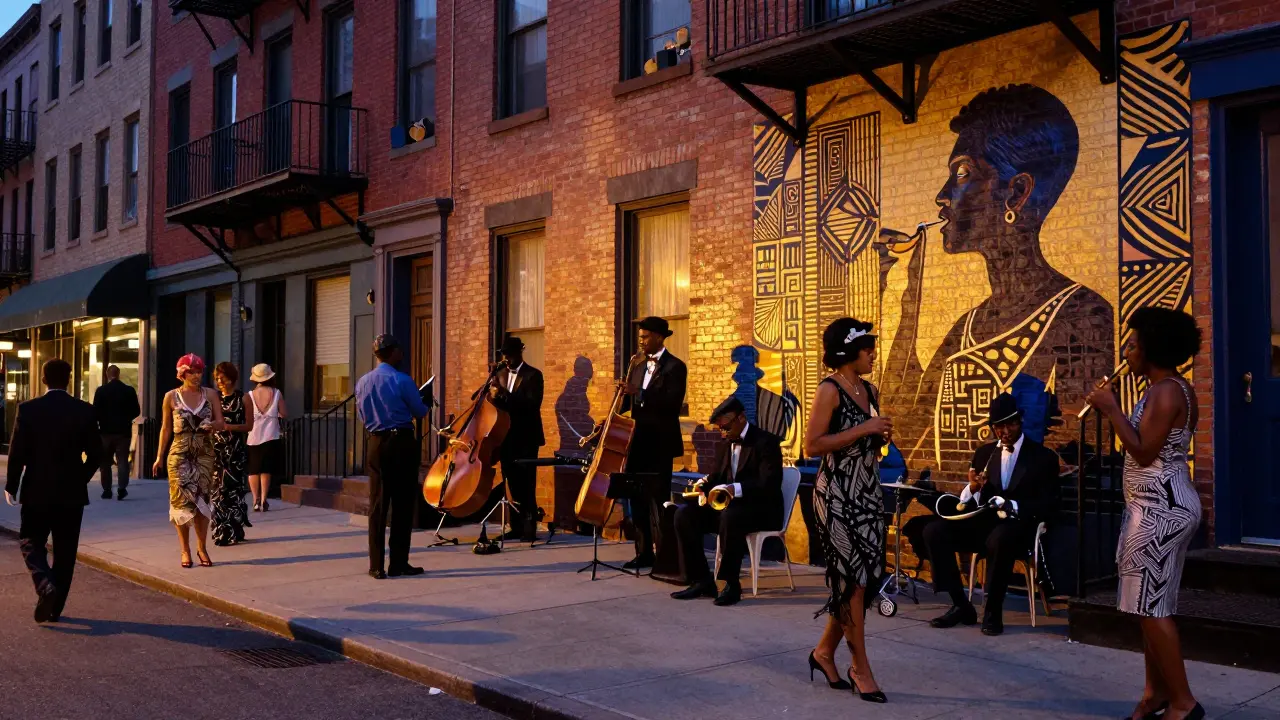
Visual artists of the Harlem Renaissance didn’t paint idealized versions of Black life. They painted real life - the dignity in a mother’s gaze, the rhythm of a street drummer, the quiet strength of an elderly man on a stoop. Aaron Douglas became one of the most iconic figures, using bold silhouettes, geometric shapes, and African-inspired motifs to create murals that told stories of slavery, resilience, and hope. His work wasn’t decoration. It was a declaration.
Photographers like James Van Der Zee captured everyday moments with elegance. His portraits of Black families, weddings, and community events showed a world rarely seen in mainstream media - one full of grace, style, and self-possession. Van Der Zee didn’t just take pictures; he built legacies. One of his most famous photos shows a young couple in formal wear, standing beside a sleek 1920s car, their smiles saying everything: we belong here, too.
Writers Who Changed the Language of Freedom
If you’ve ever read a poem about longing, pride, or the blues, you’ve felt the echo of Langston Hughes. His poetry didn’t use fancy words to sound smart. He wrote in the rhythms of jazz, the cadence of church sermons, and the speech of ordinary people. In his poem “I, Too,” he wrote: “I, too, am America.” That line wasn’t poetic flourish - it was a demand.
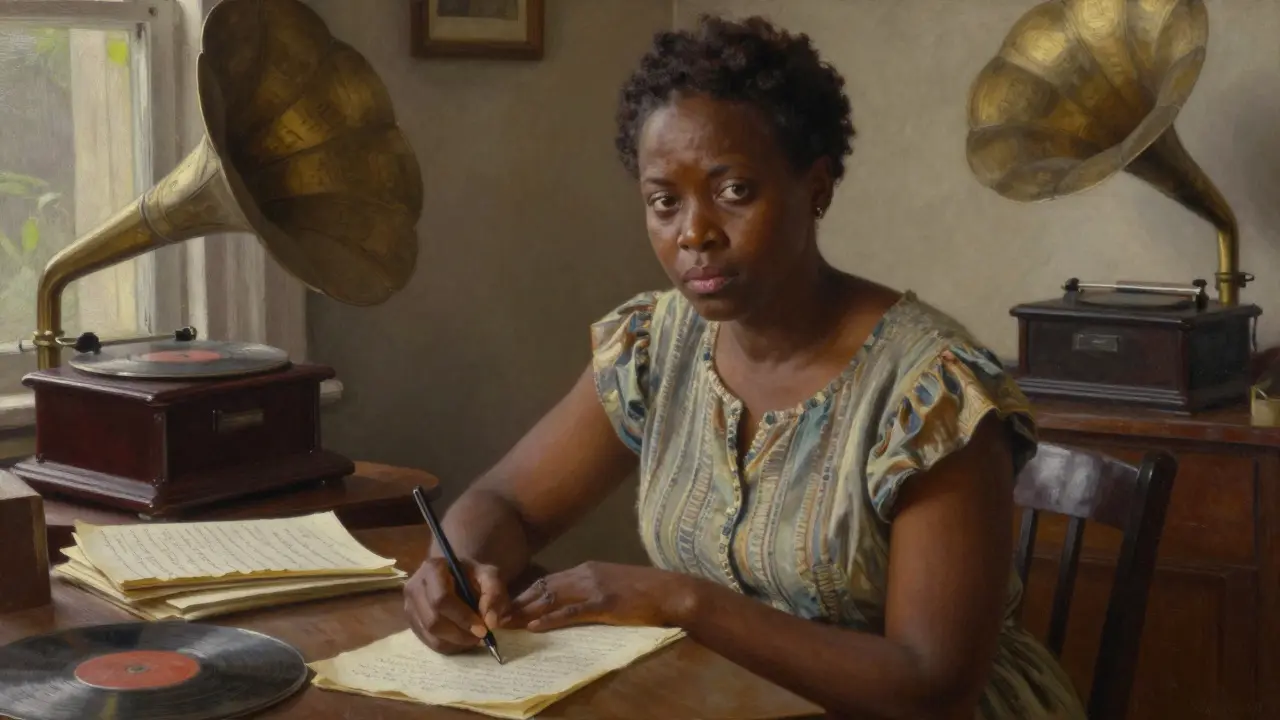
Zora Neale Hurston didn’t just write novels. She collected folklore from the rural South, preserving stories, songs, and sayings that white scholars had ignored. Her book Their Eyes Were Watching God gave us Janie Crawford - a Black woman who spoke her truth, loved fiercely, and refused to be silenced. At the time, many critics called her work “too Southern,” “too Black.” Today, it’s taught in every American literature class.
Countee Cullen, Claude McKay, and Jean Toomer also pushed boundaries. McKay’s sonnet “If We Must Die” compared Black resistance to a soldier’s last stand. Toomer’s Cane blended poetry, prose, and drama in a way no one had tried before. These writers didn’t wait for permission. They wrote anyway.
Music That Redefined America
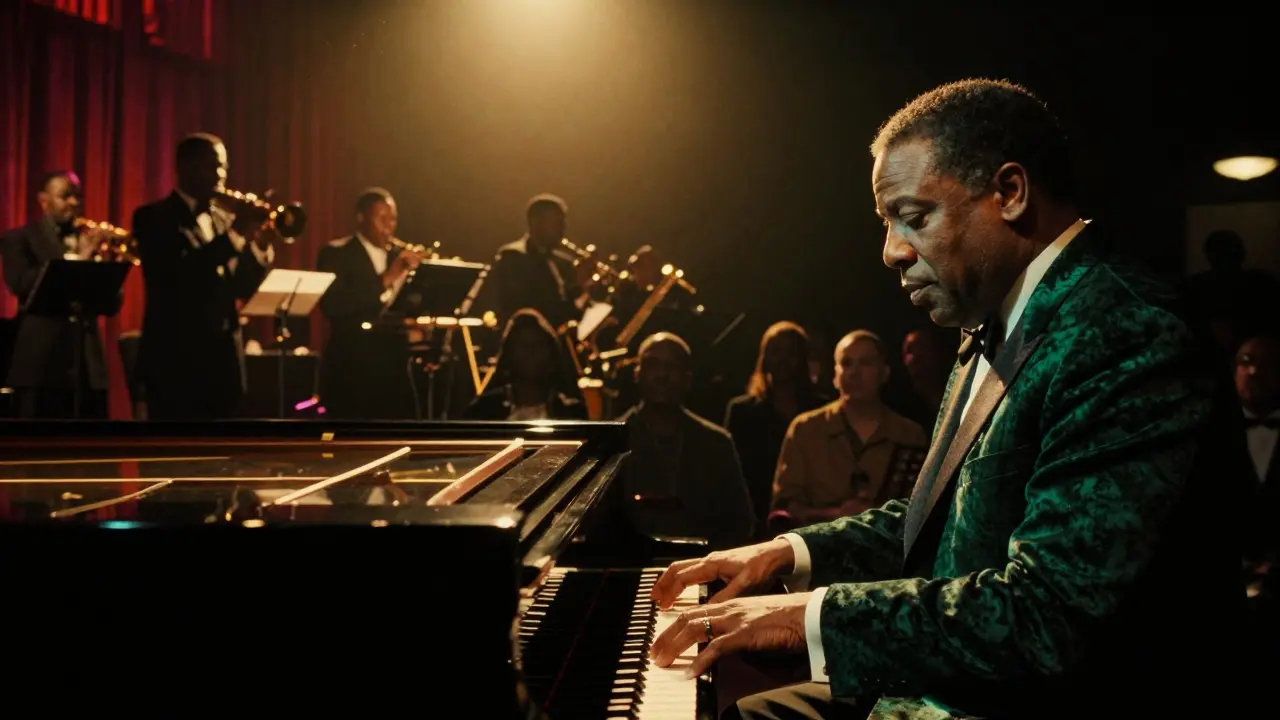
Harlem’s nightclubs didn’t just serve drinks - they changed music forever. The Cotton Club, though segregated (Black performers, white audiences), launched the careers of Duke Ellington, Bessie Smith, and Louis Armstrong. Ellington’s orchestra turned jazz into high art. Armstrong’s trumpet solos weren’t just technically brilliant - they were emotional explosions. When he played, people didn’t just listen. They felt something they couldn’t name.
Blues singers like Bessie Smith gave voice to pain, desire, and survival. Her song “Downhearted Blues” sold over 780,000 copies in 1923 - unheard of for a Black artist at the time. She didn’t sing for white approval. She sang because she had to.
Harlem’s music didn’t stay in clubs. It poured into radio waves, records, and eventually, the national consciousness. Jazz became America’s first true global export. And it was built on Black genius, Black labor, and Black joy.
Why It Mattered - And Still Does
The Harlem Renaissance didn’t end because the Great Depression hit. It ended because the world tried to silence it. White publishers still controlled what got printed. White galleries still chose what hung on walls. White audiences still paid to see Black talent but refused to sit beside them.
Yet, what was created in Harlem left a mark no force could erase. It gave Black Americans a new language - one that said: we are not broken. We are not invisible. We are creators.
Think about today. When Kendrick Lamar samples jazz in his albums. When Black Lives Matter murals cover city walls. When students read Maya Angelou’s poems in school. That’s the Harlem Renaissance still breathing.
It wasn’t about assimilation. It wasn’t about pleasing white critics. It was about ownership. Black artists claimed space, voice, and history - not as a gift, but as a right.
Legacy That Still Lives
The Harlem Renaissance didn’t vanish. It scattered. It became part of the Civil Rights Movement. It fed the Black Arts Movement of the 1960s. It echoes in every Black poet, filmmaker, designer, and activist who says: “I will tell my own story.”
Today, you can walk through the Schomburg Center for Research in Black Culture in Harlem and see original manuscripts from Hughes, Hurston, and others. The library holds over 10 million items - letters, photos, recordings - all proof that this movement was real, powerful, and enduring.
Harlem didn’t just produce art. It produced a new way of being. A way that said: Blackness isn’t a problem to solve. It’s a world to celebrate.
What triggered the Harlem Renaissance?
The Harlem Renaissance was sparked by the Great Migration, when over six million Black Americans moved from the rural South to northern cities like New York, Chicago, and Philadelphia between 1916 and 1970. In Harlem, they found relative freedom, new communities, and the space to organize. The rise of Black-owned businesses, newspapers like the Chicago Defender, and institutions like the NAACP created the conditions for cultural expression to explode.
Was the Harlem Renaissance only about art and literature?
No. While art and literature are the most visible parts, the movement was deeply political and intellectual. Scholars like W.E.B. Du Bois and Alain Locke pushed for racial pride and cultural autonomy. Locke’s 1925 anthology The New Negro became a manifesto, arguing that Black people must define themselves, not let white society do it for them. Activists, educators, and labor organizers were all part of the same wave.
Why did the Harlem Renaissance decline?
The 1929 stock market crash and the Great Depression hit Black communities hardest. Many artists lost funding. White patrons who once supported Black artists pulled back. Harlem’s economy collapsed. The movement didn’t disappear - it transformed. Artists carried its spirit into new forms, and the ideas lived on in later movements like the Civil Rights era and Black Power.
Were all Harlem Renaissance figures from Harlem?
Not at all. Many key figures lived elsewhere but were connected to Harlem’s network. Zora Neale Hurston was from Florida, Langston Hughes spent time in Europe, and Aaron Douglas studied in Kansas City. Harlem was the hub, not the birthplace. The movement was a network - linked by letters, publications, and travel - not just geography.
How did white audiences respond to the Harlem Renaissance?
White audiences were fascinated but often exploitative. Clubs like the Cotton Club hired Black performers but barred Black patrons. White publishers bought Black writers’ work but edited out their most radical ideas. Some white critics praised the art while ignoring the people behind it. Still, many Black artists used this attention to reach wider audiences, even if it came with compromises.
The Harlem Renaissance didn’t need permission to begin. It didn’t need approval to last. It simply refused to be erased - and that’s why it still matters.