You might think a style from the 1730s has nothing to do with your 2026 living room, but look closer. The obsession with 'maximalism' returning to TikTok and Instagram, the love for curved 'kidney' sofas, and the trend of mixing vintage gold frames with clean white walls all stem from the Rococo spirit. It isn't just about being "fancy"; it's about a rebellion against rigid rules in favor of emotion and whimsy.
Quick Takeaways: The Essence of Rococo
- Asymmetry: Unlike the balanced perfection of the Renaissance, Rococo loves the "S" and "C" curves.
- Pastel Palette: Cream, mint green, pale blue, and soft pink replace the dark, moody tones of the earlier Baroque era.
- Nature-Inspired: Shells, pebbles, acanthus leaves, and floral vines crawl across walls and furniture.
- Light and Air: Use of massive mirrors and large windows to bounce light and create a sense of openness.
Breaking Away from the Heavy Baroque
To understand why Rococo happened, you have to understand what it was escaping. Baroque was the style of absolute power. Think of the Palace of Versailles under Louis XIV-huge, symmetrical, dark, and designed to make you feel small. It was a style for the state, meant to intimidate.
When the focus shifted to the private townhouses (hôtels particuliers) of Paris, the vibe changed. People wanted rooms for chatting, flirting, and drinking tea, not for standing in awe of a monarch. This gave birth to the rocaille-the shell-like ornamentation that defines the era. While Baroque was a shout, Rococo was a whisper, a giggle, and a dance. It moved art from the public square into the private boudoir.
The Anatomy of a Rococo Space
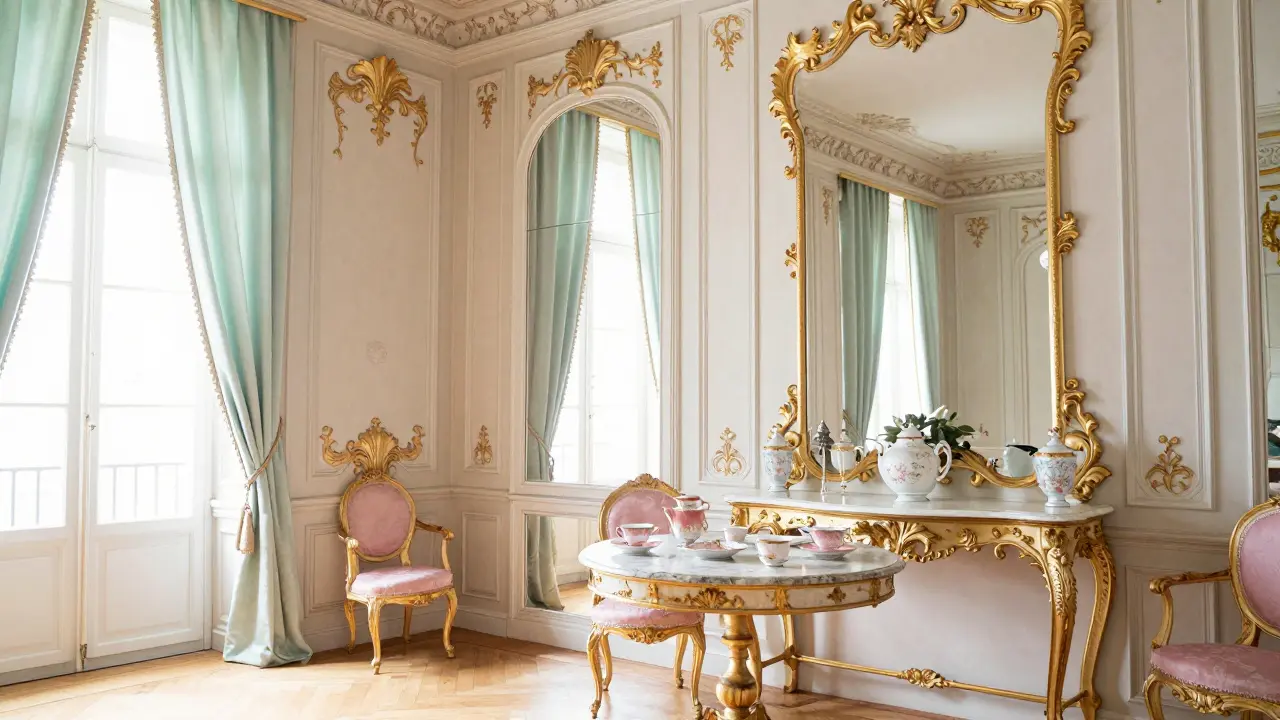
If you were designing a room in 1740, you wouldn't just put furniture in a room; you would treat the entire room as a single piece of sculpture. This is known as the Gesamtkunstwerk, or a total work of art. The walls wouldn't just be painted; they would be covered in Boiserie, which is intricate carved wood paneling usually painted in light colors and gilded with gold leaf.
The furniture of this time, such as the cabriole leg (the S-curved leg on a chair), was designed for comfort. For the first time, chairs became easier to actually sit in, reflecting a move toward domestic intimacy. Everything was meant to be light, airy, and effortlessly elegant. If it looked too heavy to move, it wasn't Rococo.
| Feature | Baroque (The Predecessor) | Rococo (The Evolution) |
|---|---|---|
| Mood | Grand, dramatic, intimidating | Playful, intimate, lighthearted |
| Colors | Deep reds, golds, dark browns | Pastels, cream, white, light gold |
| Symmetry | Strictly symmetrical | Asymmetrical and organic |
| Purpose | Glorifying the state/church | Private pleasure and social grace |
How Rococo Lives on in Modern Design
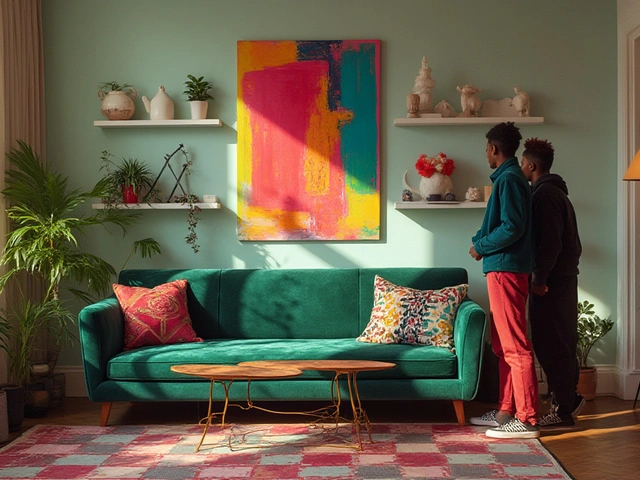
You don't need to live in a French chateau to use Rococo principles. In fact, some of the biggest trends in current modern interior design are just Rococo in a different outfit. Take the current trend of maximalism. After decades of "sad beige" minimalism, people are craving texture, color, and a bit of chaos. That is pure Rococo energy.
Consider the curvilinear design seen in high-end furniture today. The resurgence of organic shapes-think of the undulating lines of Zaha Hadid's architecture or the rounded edges of a contemporary velvet sofa-is a direct descendant of the Rococo obsession with natural, flowing forms. We are moving away from the "box" and back toward the "curve."
Even our lighting choices reflect this. The modern love for statement chandeliers paired with minimalist rooms creates a high-contrast look. By placing a highly ornate, gold-finished piece (a Rococo element) in a stark white room (a Modernist element), you create a focal point that feels curated rather than cluttered. This is often called "eclectic luxury" and is the most common way Rococo influences high-end homes today.
Practical Ways to Add Rococo Flair Today
If you want to bring this opulence into your space without making it look like a museum, you have to balance the "extra" with the "essential." Here is how to do it without overdoing it:
- The Statement Frame: Find a heavy, gilded Rococo mirror or picture frame from a thrift store. Place it against a plain, neutral wall. The contrast between the intricate gold carving and the flat wall makes the frame look like a piece of art itself.
- Pastel Accents: Use a palette of sage green or dusty rose for your throw pillows or bedding. These colors are Rococo's signature and instantly soften the mood of a room.
- Organic Textures: Incorporate elements that mimic nature. This could be a shell-shaped side table or a floral-patterned wallpaper in a small powder room.
- Curved Furniture: Swap a rectangular coffee table for an oval or kidney-shaped one. The lack of sharp corners makes the room feel more fluid and welcoming.
The Psychological Impact of the Style
Why does this style still work? Because Rococo is fundamentally about joy. While the Renaissance was about logic and the Baroque was about power, Rococo was about the pleasure of the senses. When we bring these elements into our homes-the soft fabrics, the shimmering gold, the floral patterns-we are subconsciously creating a space for relaxation and leisure.
In a world that feels increasingly digital and sterile, the tactile richness of Rococo provides a necessary human touch. It reminds us that design doesn't always have to be "efficient" or "functional." Sometimes, design can just be beautiful for the sake of being beautiful.
Is Rococo the same as Baroque?
No, though they are related. Baroque is the "parent" style-heavy, symmetrical, and dramatic. Rococo is the "child" style-lighter, asymmetrical, and more playful. If Baroque is a massive opera house, Rococo is a cozy, decorated tea room.
How do I stop Rococo decor from looking "tacky"?
The secret is contrast. Use the 80/20 rule: 80% of your room should be clean, modern, or neutral, and 20% should be the ornate Rococo elements. This prevents the space from feeling like a costume shop and makes the luxury pieces actually stand out.
What are the key colors of the Rococo period?
Rococo moved away from the deep reds and golds of the previous era. Instead, it used "candy colors" like mint green, pale yellow, baby blue, cream, and soft pink, often paired with white and gold leaf accents.
Where can I see authentic Rococo design today?
The best examples are in the palaces and hotels of Paris and Germany. The Hotel Particulars in Paris are prime examples of the intimate, decorative style. You can also see its influence in the mirrored halls of many European estates.
Why was the shell shape so important in Rococo?
The term "Rococo" comes from the French word "rocaille," which means shell or pebble work. Shells provided a natural, asymmetrical shape that artists could mimic to break away from the boring straight lines of classical architecture.
Next Steps for the Design Enthusiast
If you've fallen in love with the whimsy of this era, don't stop here. To deepen your understanding of how curves and luxury evolve, explore the Art Nouveau movement of the late 19th century. It took the organic nature of Rococo and merged it with industrial materials like iron and glass. Alternatively, look into Maximalism in contemporary 2026 trends to see how current designers are mixing high-art history with pop culture. Start by picking one small corner of your home and treating it as a "pleasure zone"-add a gold frame, a pastel candle, and a curved chair, and see how the energy of the room shifts.