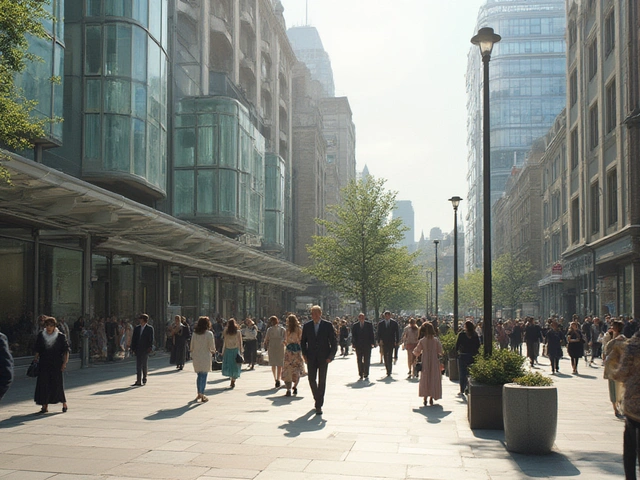
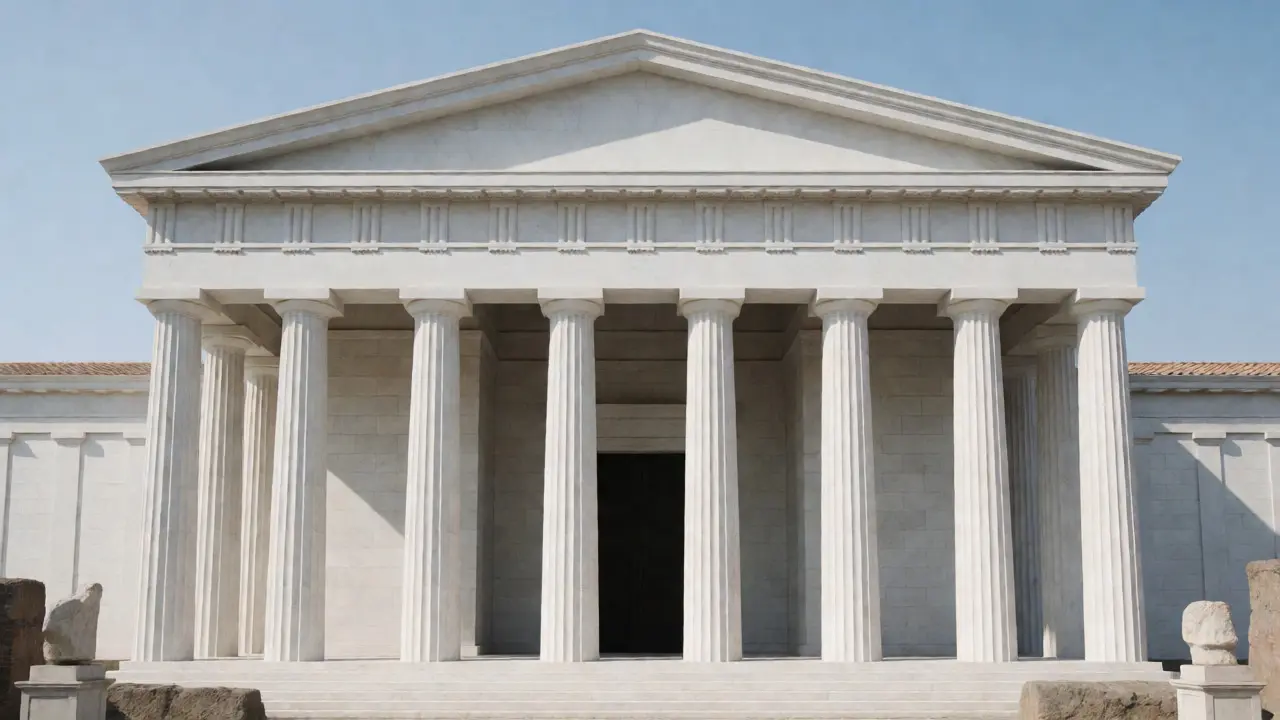
You walk into a museum, or maybe just look at a government building in your city, and you feel it. A sense of calm. Order. Everything lines up perfectly on both sides. That feeling? That is Neoclassicism doing its job. It is not just an old style; it is a deliberate choice to reject chaos in favor of clarity.
But why did artists and architects suddenly decide that the messy, emotional drama of the previous era was too much? And how did they use simple tools like symmetry and balance to change the way we see beauty? If you have ever wondered why some buildings feel "right" while others feel overwhelming, this guide breaks down the core principles of Neoclassical art. We will look at the history, the techniques, and the lasting impact of this movement on modern design.
Quick Summary / Key Takeaways
- Reaction to Rococo: Neoclassicism emerged as a direct response to the excessive ornamentation of the Rococo style, prioritizing simplicity and moral seriousness.
- Ancient Inspiration: Artists studied excavations of Pompeii and Herculaneum to replicate Greek and Roman aesthetics accurately.
- Symmetry as Structure: Unlike earlier styles, symmetry was used for structural integrity and visual harmony, not just decoration.
- Political Tool: The style became associated with democracy and republicanism, influencing major political buildings worldwide.
- Enduring Legacy: Its principles still dictate how banks, courthouses, and universities are designed today.
The Historical Shift: Why Simplicity Became Trendy
To understand Neoclassicism, you have to look at what came before it. By the mid-18th century, Europe was saturated with Rococo art. This style was all about pastel colors, gold leaf, curvy shapes, and playful themes. Think of French aristocrats lounging in gardens, surrounded by unnecessary frills. It was beautiful, sure, but many intellectuals started viewing it as frivolous and morally shallow.
Then came the archaeological discoveries. In the 1740s, the cities of Pompeii and Herculaneum were excavated near Naples. Suddenly, people could see actual ancient Roman life preserved under ash. They saw straight lines, bold columns, and stark realism. It wasn't fancy; it was powerful. This sparked a massive cultural shift. People stopped wanting whimsy and started craving virtue, duty, and civic responsibility.
This wasn't just an artistic trend; it was a philosophical movement. Enlightenment thinkers argued that society needed reason, not emotion. Art had to reflect that. Enter Neoclassicism. It stripped away the excess. It asked viewers to think, not just feel. The goal was to educate the public through clear, heroic imagery drawn from antiquity.
Defining the Core Principles: Balance and Symmetry
If you take one thing away from this article, let it be this: Neoclassicism is obsessed with order. But "order" doesn't mean boring. It means every element has a specific place and purpose. The two pillars holding this aesthetic up are balance and symmetry.
Symmetry in Neoclassicism is bilateral. Imagine folding a painting or a building facade in half. The left side mirrors the right side almost exactly. This creates a sense of stability. Your eye doesn't wander; it rests in the center. In architecture, this meant porticos centered over doors, columns spaced evenly, and windows aligned in perfect rows.
Balance, however, is broader. While symmetry is a type of balance, Neoclassicists also used asymmetrical balance to create dynamic yet stable compositions. They achieved this through weight distribution. A large figure on one side might be balanced by a group of smaller figures or architectural elements on the other. The key is that neither side feels heavier than the other.
Why does this matter? Because human brains are wired to find symmetrical faces and structures trustworthy. When a bank uses Neoclassical design, it subconsciously tells you, "Your money is safe here." When a courthouse uses it, it says, "Justice is impartial." The art isn't just decoration; it's communication.
Architecture: Building the Republic
Nowhere is Neoclassicism more visible than in architecture. This style defined the skylines of new democracies. After the American Revolution and the French Revolution, leaders wanted buildings that looked different from the palaces of kings. They didn't want spires reaching to heaven (Gothic) or domes floating in clouds (Baroque). They wanted temples.
Thomas Jefferson, the third U.S. President, was a huge fan. He designed his home, Monticello, and the University of Virginia using strict Neoclassical rules. He believed that if Americans lived among clean lines and rational proportions, they would become better citizens.
Let's look at the common features you can spot in real life:
- Columns: Usually Doric or Ionic orders. They support entablatures, creating a strong horizontal line.
- Pediments: Triangular gables above entrances, often filled with relief sculptures of heroes or gods.
- Domes: Inspired by the Pantheon in Rome, these symbolize unity and grandeur without being overly ornate.
- Materials: White marble or stone. Color was kept minimal to emphasize form over decoration.
Compare this to the Baroque churches in Italy. Those are dark, dramatic, and full of shadows. Neoclassical buildings are bright, open, and legible. You can understand the structure from the outside. There are no secrets hidden in the walls.
Painting and Sculpture: Heroism in Stone and Canvas
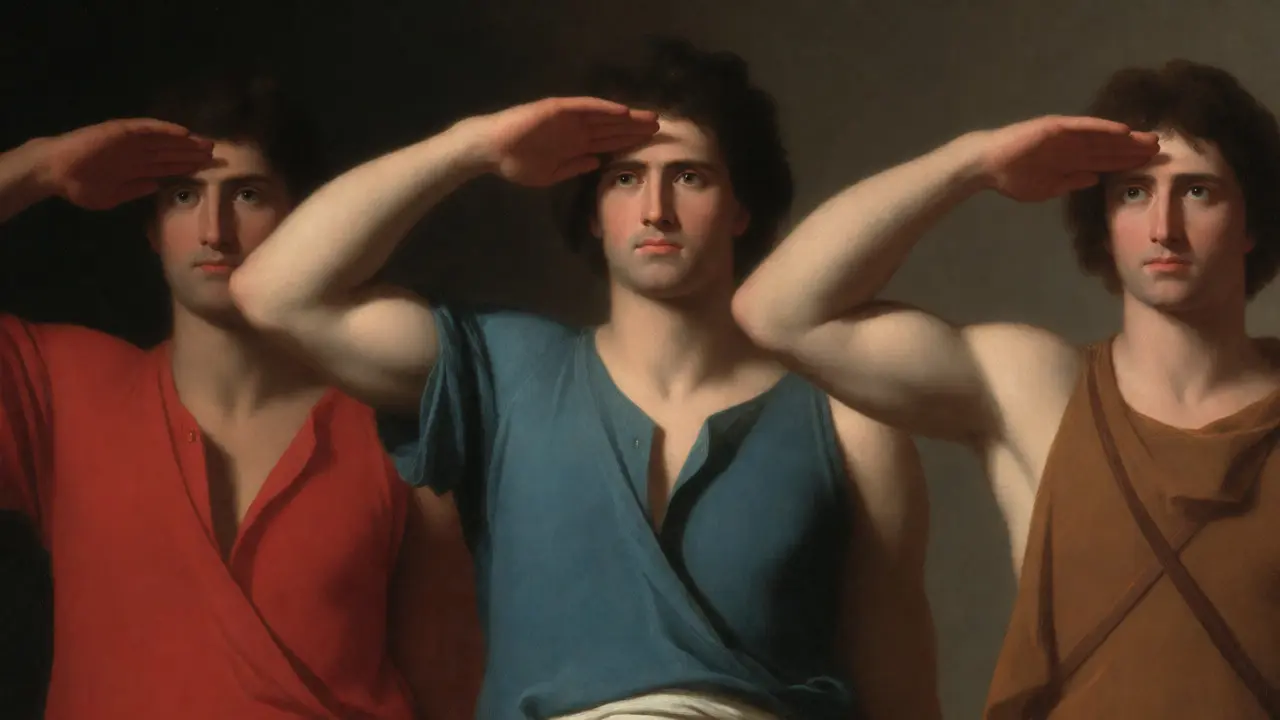
In painting, Neoclassicism replaced soft, blurry edges with sharp outlines. Artists like Jacques-Louis David became famous for works like "The Oath of the Horatii." Look closely at that painting. Three brothers salute their father. Their muscles are tense. Their arms are straight. The background is plain. There is no distraction. The focus is entirely on the moral decision they are making.
This technique is called "linear perspective." It draws your eye directly to the action. Colors are muted-reds, blues, earth tones. No neon pinks or shimmering golds. The light is even, like daylight, not the dramatic spotlight of Caravaggio.
Sculpture followed similar rules. Antonio Canova created statues that looked like idealized humans. His figures weren't sweating or crying; they were calm and composed. He polished marble until it looked like skin, but the poses remained static and dignified. The message? Humans should control their emotions with reason.
| Feature | Rococo Style | Neoclassical Style |
|---|---|---|
| Mood | Playful, romantic, frivolous | Serious, heroic, moralistic |
| Color Palette | Pastels, gold, bright accents | Earth tones, white, muted primaries |
| Composition | Asymmetrical, curved, flowing | Symmetrical, linear, structured |
| Subject Matter | Love affairs, mythology, leisure | Virtue, sacrifice, historical events |
| Target Audience | Aristocracy and royalty | Bourgeoisie and emerging democracies |
How to Spot Neoclassicism Today
You don't need a degree to identify this style. Next time you are walking downtown, look for these signs. If a building has a triangular roof section supported by columns, it is likely Neoclassical or influenced by it. If the windows are square and arranged in a grid, that is another clue.
Inside museums, look for paintings where the figures look like statues. If everyone is posing perfectly and nobody looks messy, you are probably looking at Neoclassical work. The scenes often depict moments of high tension but low emotion-like signing a treaty or accepting a death sentence calmly.
It is also worth noting that Neoclassicism wasn't a monolith. It evolved. Early phases were stricter, copying Roman forms exactly. Later phases, sometimes called "Empire Style," added military symbols and imperial eagles, especially during Napoleon's rule. But the core demand for balance never went away.
The Lasting Impact on Modern Design
Did Neoclassicism die out? Not really. It transformed. By the late 19th century, it gave way to Romanticism, which brought back emotion and nature. But the DNA of Neoclassicism remains in our daily lives.
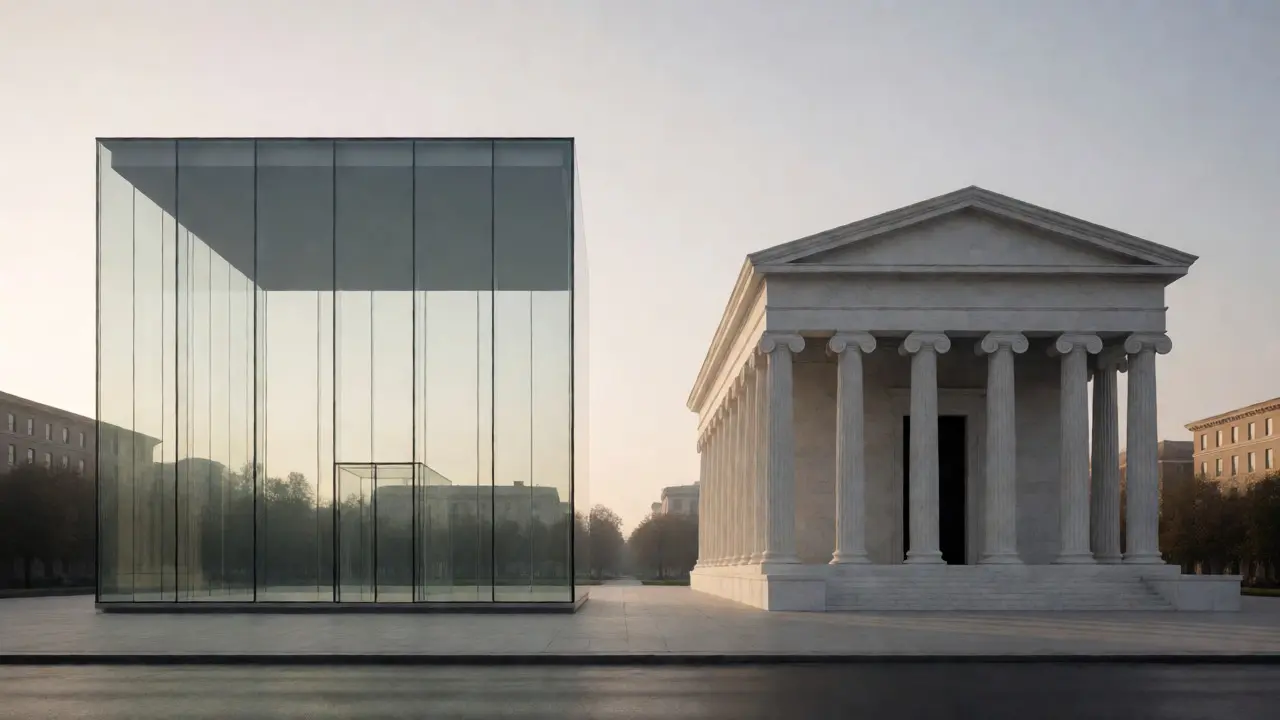
Think about modern minimalist architecture. Clean lines, lack of ornament, functional beauty. That is the great-grandchild of Neoclassicism. When Apple builds a glass cube store, they aren't using columns, but they are using the same principle: clarity and balance. They remove everything unnecessary so the object itself speaks.
Furthermore, the idea that art should serve a civic purpose persists. Public libraries, town halls, and museums still borrow heavily from this tradition. They want to project authority and permanence. Neoclassicism taught us that design can influence behavior. If you surround people with order, they may act more orderly.
So, the next time you see a symmetrical facade or a statue standing tall and calm, pause. Recognize the effort behind that simplicity. It took centuries of debate to decide that less is more, and that balance is the ultimate form of beauty.
What is the main difference between Neoclassicism and Classicism?
Classicism refers to the original art of Ancient Greece and Rome. Neoclassicism is the revival of those styles in the 18th and 19th centuries. While Classicism was the source material, Neoclassicism was a conscious reaction against the Rococo style, adapting ancient ideals to fit modern political and social contexts, such as democracy and industrialization.
Why is symmetry so important in Neoclassical art?
Symmetry represents order, reason, and stability. During the Enlightenment, philosophers valued logic over emotion. Symmetrical compositions provided a visual metaphor for this logical order. It made art feel predictable and trustworthy, contrasting sharply with the chaotic, asymmetrical designs of the preceding Rococo period.
Who were the most famous Neoclassical artists?
In painting, Jacques-Louis David is the central figure, known for works like 'The Death of Socrates'. In sculpture, Antonio Canova was the leading master, celebrated for his polished marble statues like 'Psyche Revived by Cupid's Kiss'. Architects like Robert Adam and Thomas Jefferson also played crucial roles in spreading the style across Europe and America.
Is Neoclassicism still relevant today?
Yes, its principles are deeply embedded in modern design. Minimalist architecture, corporate branding, and government buildings often rely on Neoclassical ideas of balance, clarity, and restraint. The emphasis on functionality and clean lines in contemporary design is a direct descendant of Neoclassical philosophy.
How did archaeology influence Neoclassicism?
The excavation of Pompeii and Herculaneum in the 1740s provided artists with accurate references for ancient Roman life. Before these digs, designers relied on vague interpretations of antiquity. The discoveries revealed precise details about furniture, clothing, and architecture, allowing Neoclassical creators to mimic ancient styles with unprecedented accuracy.