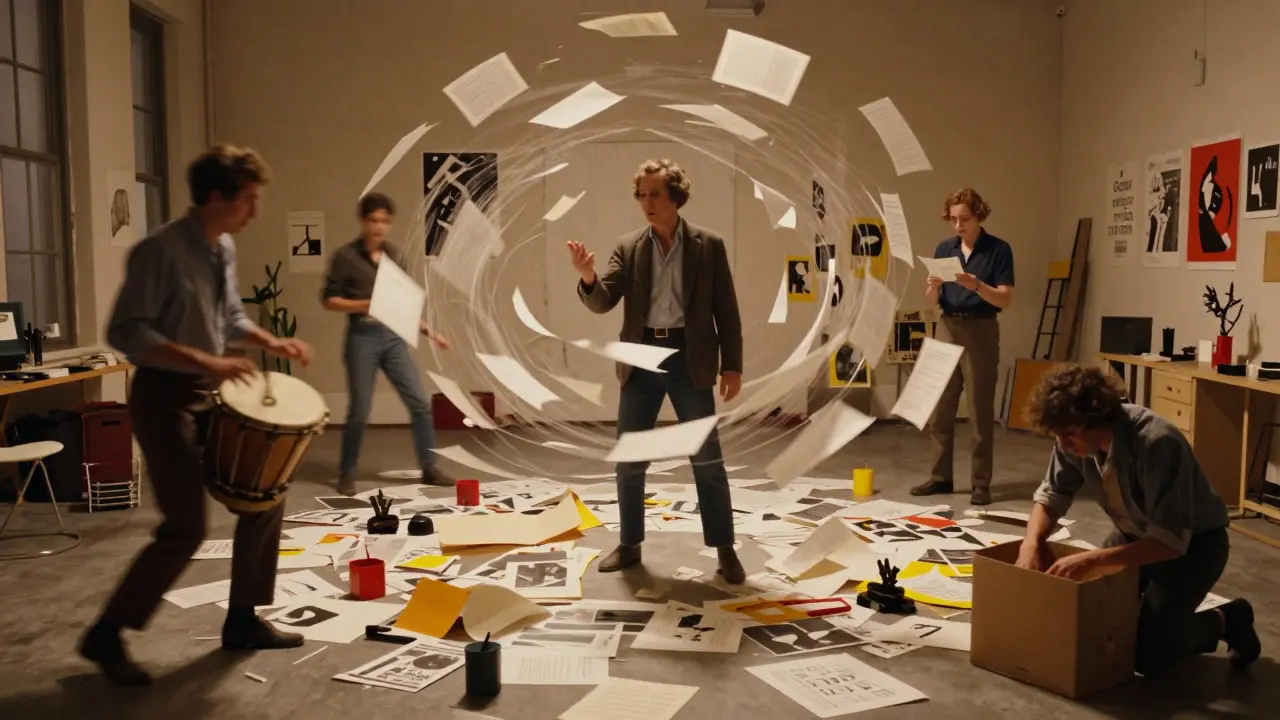
Imagine a concert where the "music" is a man running around with a microphone while a drummer hits an empty snare. Or a gallery exhibition that lasts only one second before being destroyed by the audience. This isn't a glitch in the matrix; it was just a Tuesday for Fluxus, an avant-garde artistic movement that shook up the definition of what art could be. Born in the late 1950s and exploding in the 1960s, Fluxus wasn't just about making pretty pictures. It was a rebellion against the commercialization of culture, the rigid rules of traditional galleries, and the idea that art had to be expensive or permanent to matter.
If you’ve ever felt that the art world is too exclusive or pretentious, you’re in good company. The founders of Fluxus felt exactly the same way. They wanted to bring art back to the people, mixing it with everyday life, music, poetry, and performance. But how did a group of scattered artists from different countries manage to create such a cohesive (yet chaotic) identity? And why does this movement still influence modern street art, digital media, and live events today?
The Origins of Chaos: Who Started Fluxus?
To understand Fluxus, you have to look at its father figure: George Maciunas. A Lithuanian-born artist who moved to New York City in the 1950s, Maciunas was a visionary with a knack for organization disguised as chaos. He didn’t start Fluxus as a formal school with a manifesto. Instead, he started it as a newsletter. In 1961, he published the first issue of the *Fluxus Newsletter*, which served as a bulletin board for his friends’ experimental projects.
The name itself is a clue to their philosophy. "Flux" comes from the Latin word for flow. Maciunas chose it because he believed art should be fluid, changing, and never static. Unlike movements like Cubism or Surrealism, which had distinct visual styles, Fluxus had no single style. One month, a Fluxus artist might perform a piece involving silence; the next, they might release a limited edition box containing a stamp, a poem, and a small sculpture. This flexibility was the point. By rejecting a fixed aesthetic, they kept the door open for anyone to participate.
Maciunas acted as the glue holding this loose network together. He organized concerts, printed publications, and shipped boxes of art objects across the globe. His role was less like a leader and more like a curator of chaos, ensuring that the energy of the movement stayed high without forcing conformity.
Key Figures and Their Contributions
While Maciunas was the organizer, the creative engine of Fluxus came from a diverse group of international artists. Each brought a unique perspective, blending European intellectualism with American pragmatism.
- Yoko Ono: Perhaps the most famous name associated with Fluxus, Ono joined the circle in the early 1960s. Her work often involved instruction pieces, where the viewer became the artist. Her *Instruction Paintings* asked audiences to do simple things like "walk on a wall" or "listen to a tree." This democratized art, removing the barrier between creator and observer.
- John Cage: The composer was a major influence. His concept of "indeterminate music," where chance played a role in composition, directly inspired Fluxus performances. Cage’s belief that silence was as important as sound paved the way for pieces like *4'33"*, which became a staple of Fluxus concerts.
- Nam June Paik: A Korean-American video artist, Paik used technology to challenge tradition. He famously smashed a piano in a performance titled *Cage Tune*. Later, he pioneered video art, showing that electronic media could be a valid artistic tool. His work bridged the gap between the analog Fluxus era and the digital age.
- La Monte Young: An American composer, Young focused on minimalism and drone music. His long-duration pieces challenged the listener’s perception of time, aligning with Fluxus’s goal to alter consciousness through experience rather than object.
These artists weren’t trying to compete with each other. Instead, they collaborated freely. It was common for a musician to help design a poster, or a poet to write lyrics for a noise band. This cross-pollination created a rich tapestry of ideas that couldn’t be contained in a single discipline.
Happenings and Events: Art in Action
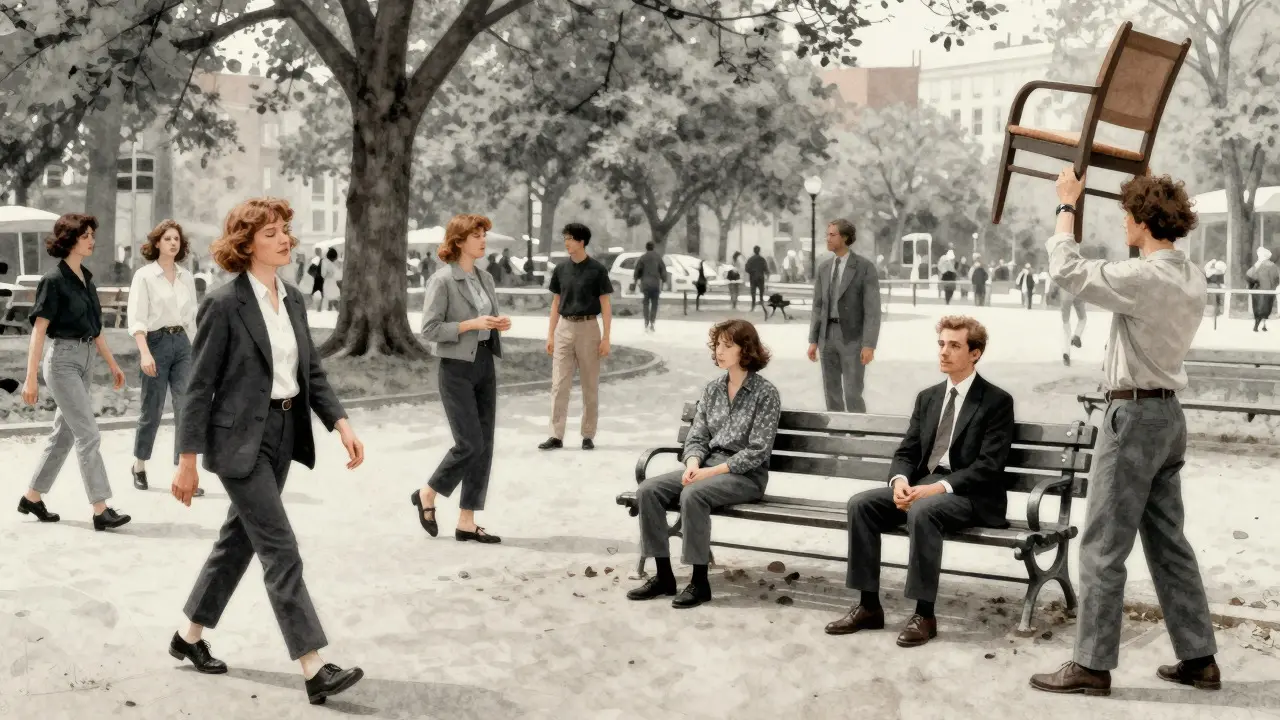
One of the most distinctive features of Fluxus was the "happening." Unlike a traditional performance with a script and a stage, a happening was an event that happened in public spaces, often with little planning. These events were designed to be spontaneous, interactive, and sometimes absurd.
A typical Fluxus happening might take place in a park, a subway station, or a living room. Participants might be asked to carry a chair over their heads, wear a blindfold, or simply sit in silence for ten minutes. The goal wasn’t to entertain in the conventional sense but to provoke thought and break down social barriers. If you attended a Fluxus concert, you weren’t just watching; you were part of the artwork. Your reaction-confusion, laughter, boredom-was data for the artist.
This approach had a profound impact on how we view live events today. Think about immersive theater, interactive museum exhibits, or even viral social media challenges. All of these borrow from the Fluxus idea that the audience is a co-creator. The line between performer and spectator blurred completely, creating a shared experience that was impossible to replicate in a gallery setting.
Fluxus Editions: Art You Can Own
You might wonder how artists made money if they were giving away performances for free. The answer lies in Fluxus Editions. These were limited-run boxes or packages containing various art objects: prints, poems, stamps, coins, and small sculptures. They were affordable, collectible, and highly portable.
The *Duchamp Box*, for example, contained items related to Marcel Duchamp, a pioneer of conceptual art. Another popular edition was the *Rauschenberg Box*, featuring works by Robert Rauschenberg. These boxes served multiple purposes. They were artworks in themselves, historical documents, and a way to fund the movement. Because they were mass-produced in small quantities, they made avant-garde art accessible to students and young collectors who couldn’t afford large canvases.
Today, Fluxus Editions are prized by collectors. A well-preserved box can sell for thousands of dollars at auction. But in the 1960s, they cost just a few dollars. This affordability was crucial. It allowed the movement to spread beyond elite circles and into universities, alternative spaces, and homes around the world.
| Feature | Traditional Fine Art | Fluxus Art |
|---|---|---|
| Medium | Oil paint, marble, bronze | Performance, sound, everyday objects, text |
| Role of Audience | Passive observer | Active participant/co-creator |
| Location | Gallery, museum | Parks, streets, homes, anywhere |
| Cost | High (exclusive) | Low (accessible via editions) |
| Permanence | Permanent object | Ephemeral event or temporary object |
The Legacy of Fluxus in Modern Culture
Did Fluxus disappear after the 1970s? Not really. It evolved. The movement officially faded as a unified group when Maciunas died in 1966, but its ideas took root deeply in the cultural soil. Many of its principles became standard practice in contemporary art.
Consider the rise of street art. Artists like Banksy or Shepard Fairey operate outside the gallery system, using public spaces to make political or social statements. This is a direct descendant of Fluxus happenings. Then there’s the world of digital art and NFTs. The idea that art doesn’t need to be a physical object-that it can be an experience, a code, or a moment-echoes the Fluxus belief in dematerializing art.
Even in corporate branding, you can see Fluxus influences. Companies now host experiential marketing events where customers interact with products in playful, unconventional ways. These events prioritize memory and engagement over product specs, much like Fluxus prioritized experience over object.
For artists today, Fluxus offers a permission slip. It says you don’t need a degree from a prestigious academy to be an artist. You don’t need expensive materials. You just need an idea and the courage to execute it. Whether you’re making a short video, organizing a community garden, or writing a poem on a napkin, you’re participating in the spirit of Fluxus.

How to Experience Fluxus Today
You don’t need to travel back in time to feel the energy of Fluxus. Here are some practical ways to engage with its legacy:
- Visit Museums with Performance Archives: Institutions like the Museum of Modern Art (MoMA) in New York or the Tate Modern in London have extensive collections of Fluxus artifacts, including videos of happenings and original editions. Watching these recordings gives you a visceral sense of the era’s energy.
- Try an Instruction Piece: Find a simple instruction-based artwork online. For example, try Yoko Ono’s *Walk for Peace*. Just walk slowly and notice your surroundings. It sounds simple, but it changes your relationship with your environment.
- Create Your Own Happening: Organize a small event for friends. Ask them to bring one object that represents a memory. Have everyone share the story behind the object. No judgment, no critique. Just sharing. That’s Fluxus in action.
- Collect Affordable Editions: Look for vintage Fluxus posters or reprints. They’re relatively inexpensive and serve as great conversation starters. Even buying a modern "Fluxus-style" zine supports the DIY ethos.
Engaging with Fluxus doesn’t require expertise. It requires curiosity. The more you let go of the idea that art must be serious or expensive, the more you’ll find it hiding in plain sight-in your daily routine, in your conversations, in the spaces between moments.
Frequently Asked Questions
What is the main difference between Fluxus and Dadaism?
While both movements use humor and absurdity to challenge art norms, Dadaism was largely a reaction to World War I and focused on anti-art as a protest. Fluxus, emerging decades later, was more about integration-blending art with life, music, and technology. Fluxus also placed a stronger emphasis on collaborative, participatory experiences rather than individual provocation.
Is Fluxus still active today?
As a formal organization, Fluxus has ended. However, its legacy lives on in countless contemporary practices. Many artists cite Fluxus as a primary influence. There are also annual festivals and exhibitions dedicated to preserving and celebrating Fluxus history, keeping the spirit alive for new generations.
Why were Fluxus Editions so important?
Fluxus Editions solved two problems: funding and accessibility. By selling small, affordable boxes of art objects, artists could earn income without relying on wealthy patrons. At the same time, these low-cost items made avant-garde art available to students and casual collectors, spreading the movement’s ideas far beyond elite circles.
Who was the most famous Fluxus artist?
Yoko Ono is likely the most widely recognized name associated with Fluxus due to her global fame as a musician and visual artist. However, John Cage and Nam June Paik are equally significant for their contributions to music and video art, respectively. George Maciunas, though less known to the general public, was the driving force behind the movement’s organization.
Can anyone be a Fluxus artist?
Yes. Fluxus rejected the idea of the "genius artist" who works in isolation. It encouraged collaboration, play, and participation. If you engage in creative acts that blend art with daily life, challenge conventions, or invite others to participate, you are practicing the core values of Fluxus.