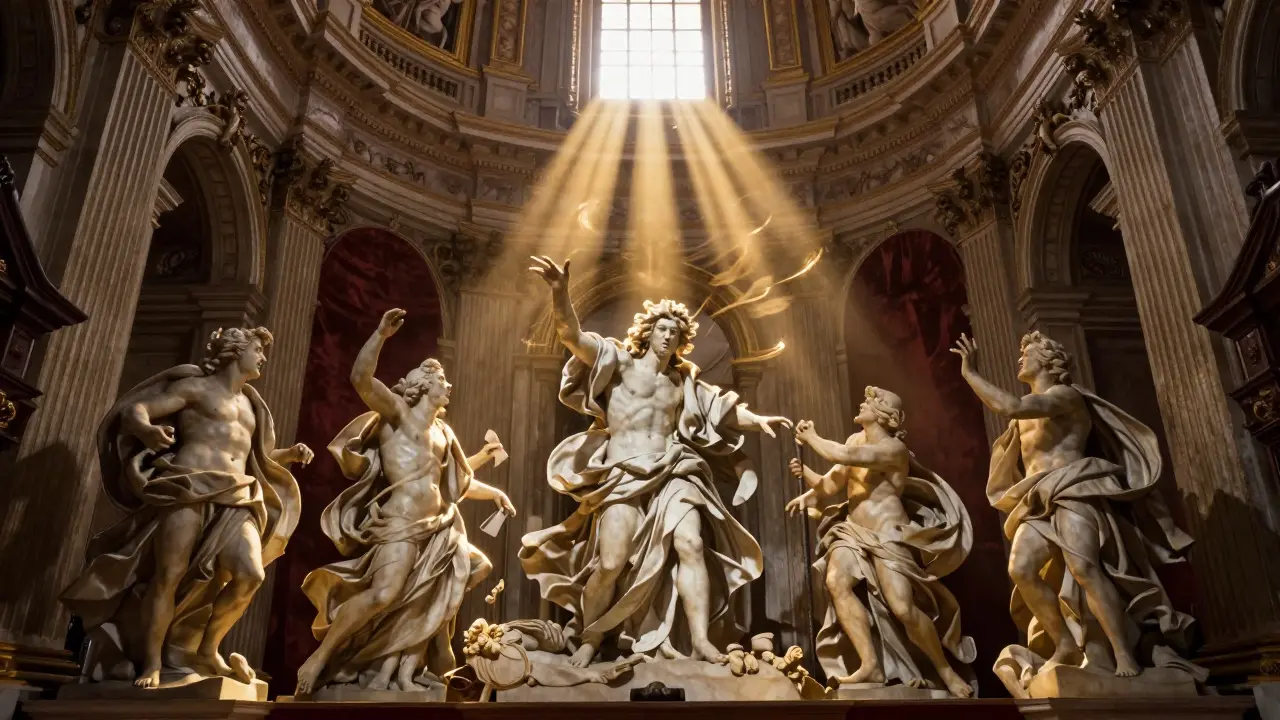
Walk into the Vatican Museums is a complex of museums and galleries in Vatican City, specifically to see Gian Lorenzo Bernini's The Ecstasy of Saint Teresa. You might expect a quiet, solemn chapel. Instead, you are hit with drama. Light floods down from a hidden window above, illuminating golden rays that seem to burst from the ceiling. Marble figures twist in emotional agony and ecstasy, their drapery flowing as if caught in a windstorm. It feels less like looking at a statue and more like witnessing a miracle in real-time. This is not just decoration; it is manipulation of your senses. This intense, theatrical energy defines the Baroque style is an ornate artistic style originating in early 17th-century Europe characterized by dramatic use of light, movement, and emotion.
We often think of history as moving in straight lines, but the Baroque era (roughly 1600 to 1750) was a reaction against order. Before this, the Renaissance prized balance, calm, and symmetry. Artists like Raphael painted perfect triangles of figures that felt stable and eternal. But the world was changing. Religious wars were tearing Europe apart. Science was revealing a universe governed by invisible forces. People didn't want calm anymore; they wanted to feel something visceral. They wanted art that grabbed them by the collar.
The Core Philosophy: Movement and Emotion
To understand why Baroque still looks fresh today, you have to look past the gold leaf and the heavy curtains. At its heart, the Baroque style is about motion. In Renaissance art, if you stopped the action, the scene would still make sense. In Baroque art, if you freeze the moment, the tension remains because the viewer’s eye is forced to move around the piece. There are no static corners.
This philosophy relied heavily on a technique called chiaroscuro is the treatment of light and shade in drawing and painting, especially strong contrasts between light and dark. Artists didn't just illuminate subjects evenly. They used deep, velvety shadows to hide parts of the composition, forcing bright highlights to pop forward. This created a stage-like effect. Think of it as a spotlight in a dark theater. The darkness isn't empty; it's heavy, adding weight to the light.
Consider Caravaggio is an Italian painter known for his realistic depictions and dramatic use of chiaroscuro. He didn't paint saints with halos floating in heaven. He painted them as rough-looking men and women from the streets of Rome, dirty feet and all, illuminated by a harsh, single light source. This grounded the divine in the physical world, making the spiritual experience immediate and tangible for the average person walking through the church.
Architecture: Breaking the Boundaries
If painting was about capturing a split second of emotion, Baroque architecture was about dissolving boundaries. Architects wanted buildings to feel alive. Walls weren't flat planes; they curved, bulged, and concaved. Cornices weren't just lines; they became sculptural elements that seemed to dance along the roofline.
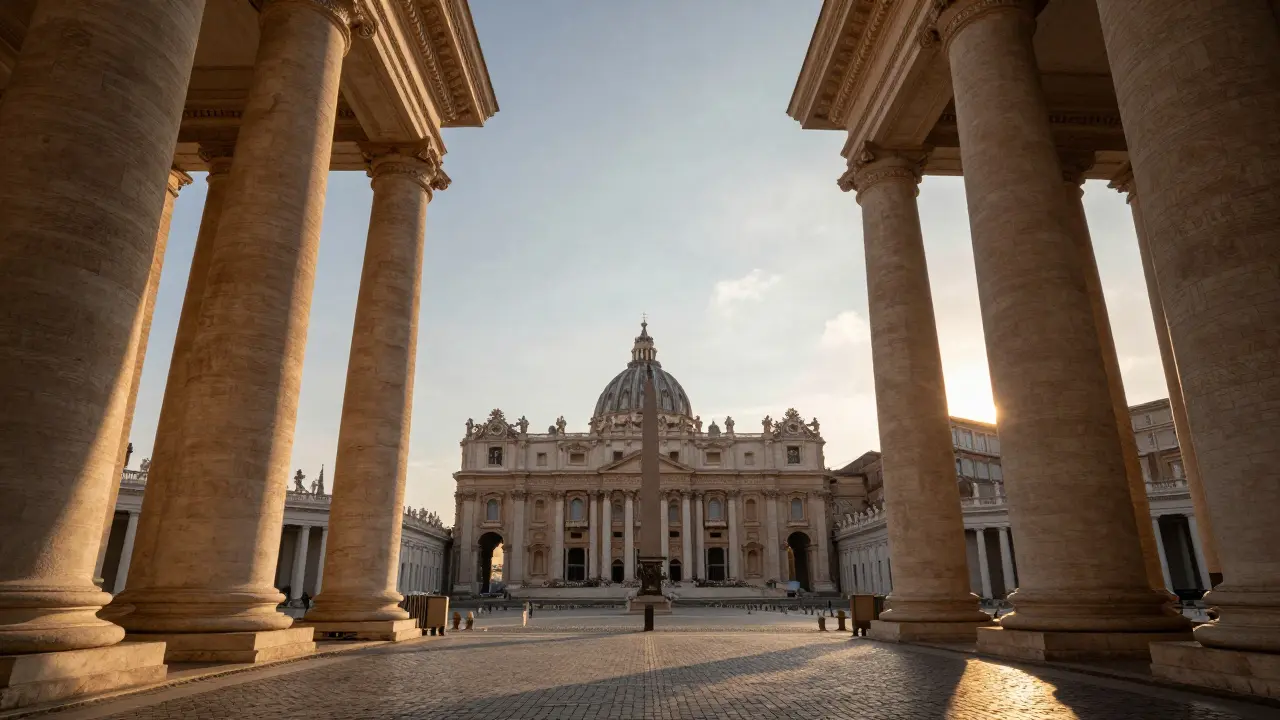
The most famous example of this is St. Peter's Square in Rome, designed by Bernini is an Italian sculptor and architect who was the dominant artist of his day in Rome. The square uses two massive colonnades that wrap around visitors like the arms of the Church embracing the faithful. As you walk toward the obelisk in the center, the perspective shifts. The columns appear to widen or narrow depending on your angle, creating a dynamic visual experience that changes as you move. This is what we call "total art" or Gesamtkunstwerk-where sculpture, architecture, and painting merge so seamlessly that you can't tell where one ends and the other begins.
In Northern Europe, particularly in Germany and Austria, this evolved into Rococo is a later, lighter phase of Baroque characterized by pastel colors, asymmetry, and playful themes. While Roman Baroque was heavy, religious, and monumental, Rococo was intimate, secular, and whimsical. It took the curves of Baroque and softened them, replacing biblical drama with scenes of aristocrats playing cards in gardens filled with shells and scrolls. Yet, both styles share the same DNA: a rejection of rigid straight lines in favor of organic flow.
| Feature | Renaissance (c. 1400-1600) | Baroque (c. 1600-1750) |
|---|---|---|
| Line & Shape | Straight lines, circles, squares; geometric stability | Curves, ovals, diagonals; dynamic movement |
| Lighting | Even, clear illumination; visible details everywhere | High contrast (chiaroscuro); dramatic spotlights |
| Emotion | Calm, rational, balanced, idealized | Intense, passionate, theatrical, realistic |
| Space | Defined, contained within the frame | Expansive, often breaking the frame into the viewer's space |
| Goal | To educate and inspire through reason | To overwhelm and convert through sensory impact |
Musical Drama: The Birth of Opera
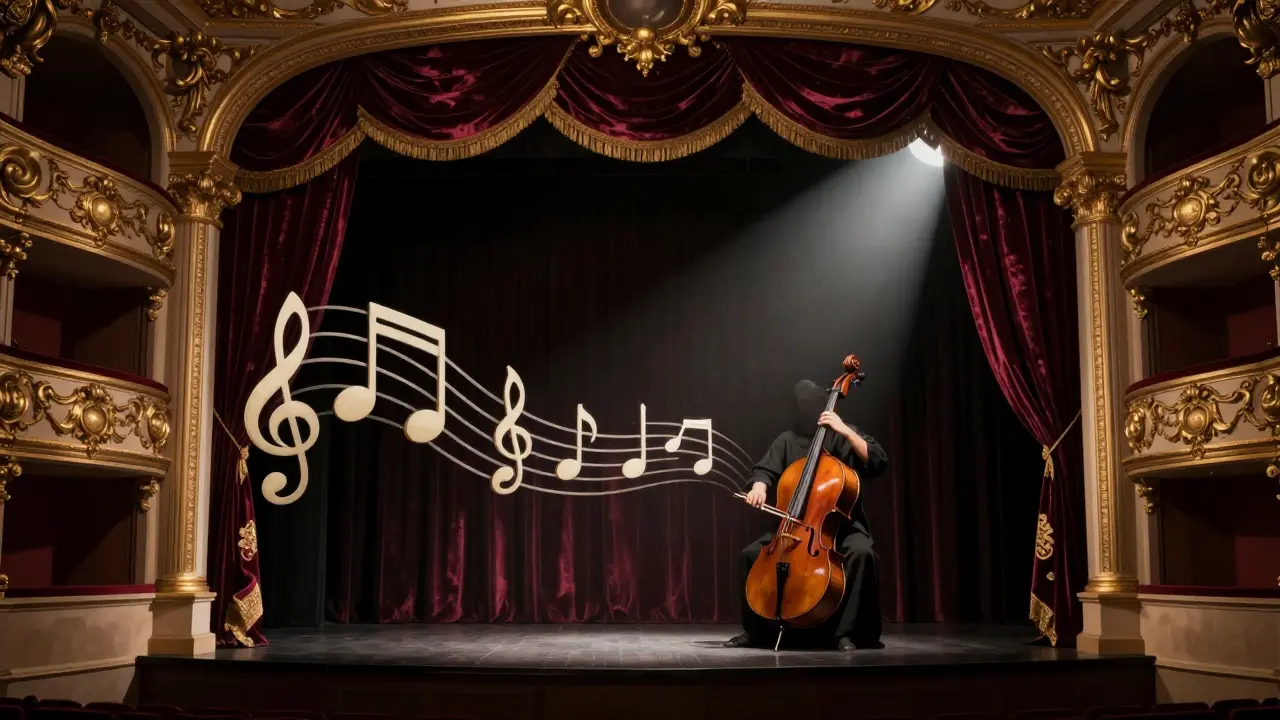
You cannot talk about Baroque without mentioning music. In fact, many historians argue that the musical innovations of this period were even more radical than the visual ones. Why? Because the Baroque era invented the modern concept of melody as we know it. Before this, music was largely polyphonic-multiple independent voices weaving together equally. Then came basso continuo is a system of musical accompaniment used in the Baroque period consisting of a bass line and improvised chords.
This technique established a clear hierarchy: a solo voice or instrument carried the main tune, supported by a steady rhythmic foundation. This allowed for unprecedented emotional expression. A singer could linger on a sad word, stretching time itself to maximize the feeling. This led directly to the birth of opera is a dramatic work set to music for singers and instrumentalists. Composers like Claudio Monteverdi is an Italian composer credited with bridging the Renaissance and Baroque periods realized that music could tell stories better than words alone. If a character was angry, the music became dissonant and fast. If they were grieving, the tempo slowed, and minor keys took over. This direct mapping of sound to emotion is the core of the Baroque aesthetic.
Johann Sebastian Bach is a German composer and musician of the Baroque period known for his technical skill and harmonic richness and George Frideric Handel is a German-born British Baroque composer known for his operas and oratorios represent the peak of this complexity. Their fugues are like architectural structures made of sound-mathematical yet deeply moving. Even if you don't listen to classical music regularly, you likely recognize the opening bars of Handel’s Hallelujah Chorus. It works because it doesn't ask you to analyze it; it asks you to feel the grandeur.
Why Does Baroque Still Matter?
So, why do we care about a style from four hundred years ago? Because the Baroque impulse is alive in our modern media. When you watch a blockbuster movie with sweeping camera movements, intense close-ups, and a score that swells to manipulate your tears, you are experiencing Baroque storytelling. The style taught us that art isn't just about representation; it's about experience.
In interior design, the "Baroque revival" happens every few decades. We crave ornamentation when minimalism becomes too sterile. The current trend of mixing vintage mirrors, velvet textures, and bold lighting fixtures is a direct descendant of Baroque sensibilities. It reminds us that comfort isn't always about simplicity; sometimes it's about richness and warmth.
Moreover, the Baroque era represents a crucial shift in how humans view themselves. It moved away from the idea that we are small observers of a perfect, ordered universe (Renaissance) to the realization that we are active participants in a chaotic, emotional, and beautiful world. That perspective shift resonates deeply today, in an age defined by rapid change and digital saturation.
Identifying Baroque Elements in Daily Life
If you want to spot Baroque influences outside of museums, look for these three things:
- Asymmetry in Balance: Look for objects that aren't perfectly mirrored but still feel stable. A vase with a twisted neck, or a room layout that flows rather than boxes.
- Dramatic Contrast: High contrast in color or light. Dark walls with bright artwork, or black-and-white photography with stark shadows.
- Ornament as Structure: Details that aren't just added on top but are part of the form. Moldings that curve into arches, or patterns that seem to grow organically from the material.
The next time you see a building with a curved facade or hear a piece of music that builds tension before releasing it, remember: you're encountering the legacy of a style that decided life was too interesting to be static.
What is the main difference between Baroque and Rococo?
While both styles feature curves and ornamentation, Baroque is generally heavier, darker, and more serious, often used for religious and state power. Rococo, which emerged later, is lighter, brighter, and more playful, focusing on leisure, romance, and domestic interiors. Think of Baroque as a powerful opera and Rococo as a witty salon conversation.
Who are the most important Baroque artists?
Key figures include Caravaggio (painting), Rembrandt (painting), Gian Lorenzo Bernini (sculpture and architecture), Diego Velázquez (painting), and Johann Sebastian Bach (music). These individuals defined the dramatic and emotional standards of the era.
When did the Baroque period end?
The Baroque period is generally considered to have ended around 1750, coinciding with the death of J.S. Bach and the rise of the Neoclassical movement, which sought to return to the simpler, more orderly forms of ancient Greece and Rome.
Is Baroque style popular in modern home decor?
Yes, elements of Baroque design remain popular. Modern interpretations often use "Neo-Baroque" features such as ornate mirrors, crystal chandeliers, rich fabrics like velvet, and gilded accents to add luxury and drama to contemporary spaces.
How does Baroque music differ from Classical music?
Baroque music is characterized by complex counterpoint, basso continuo, and sustained emotional states within a single movement. Classical music, which followed, emphasizes clearer melodies, homophonic texture (melody with chordal support), and greater variety in mood and dynamics within pieces.