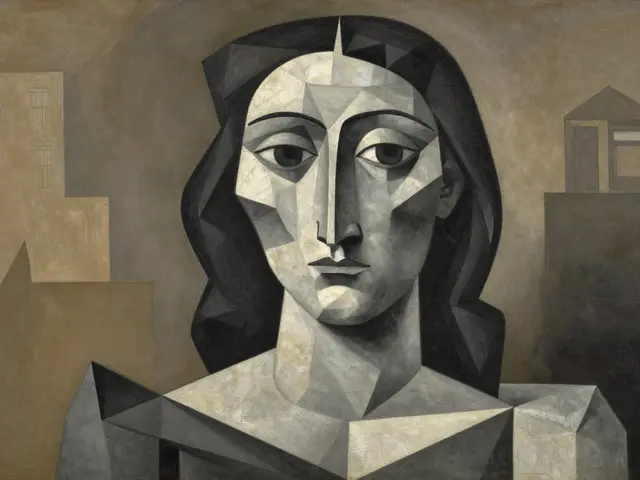
Have you ever looked at a painting and felt a sudden rush of anxiety, joy, or despair? That is the power of Expressionism, an artistic movement that prioritizes inner emotion over external reality. Unlike Impressionism, which sought to capture the fleeting play of light on water, Expressionism aimed to capture the raw, often turbulent feelings of the human soul. It is not about how things look; it is about how they feel.
This movement did not start in a vacuum. It emerged in early 20th-century Europe as a reaction against industrialization, urbanization, and the rigid traditions of academic art. Artists wanted to scream their truths onto canvas, using distorted forms, jarring colors, and aggressive brushwork to communicate directly with the viewer’s psyche. If you want to understand modern art, you have to understand this shift from observation to expression.
The Birth of Emotional Truth
To grasp what makes Expressionism a radical departure from realism, we need to look at its roots. Before Expressionism dominated, the art world was largely controlled by Realism and Naturalism. These styles demanded accuracy. A face had to look like a face. A tree had to look like a tree. But artists like Edvard Munch began to ask: What if the face looks twisted because the person is terrified? What if the sky is red because the air is heavy with dread?
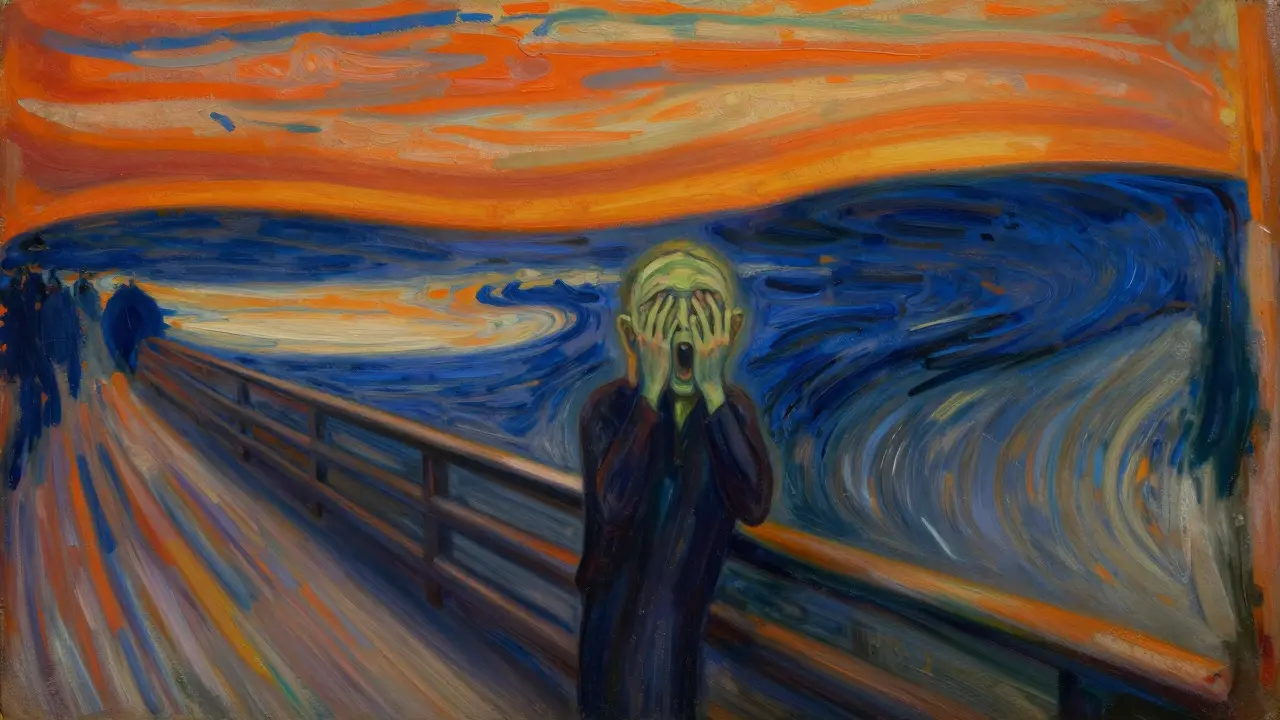
Edvard Munch, a Norwegian painter, is often cited as the grandfather of this movement. His 1893 masterpiece, The Scream, is the ultimate example. The figure is not screaming; the figure is reacting to a scream passing through nature. The background swirls in violent orange and blue hues, mirroring the protagonist’s internal panic. This wasn’t a mistake in technique; it was a deliberate choice to visualize psychological states. Munch proved that color could be used symbolically rather than descriptively.
This idea spread quickly. By 1905, groups of young German artists were forming collectives to push these boundaries further. They rejected the polished finish of previous generations. Instead, they embraced roughness, immediacy, and intensity. They believed that art should serve as a moral and spiritual corrective to the cold, mechanical world they lived in.
Die Brücke: The Bridge to Modernity
In Dresden, Germany, four architecture students founded a group called Die Brücke (The Bridge) in 1905. Led by Ernst Ludwig Kirchner, Erich Heckel, Karl Schmidt-Rottluff, and Fritz Bleyl, this group became one of the most influential forces in early Expressionism. Their name suggested they were building a bridge between the past and a new, more honest future.
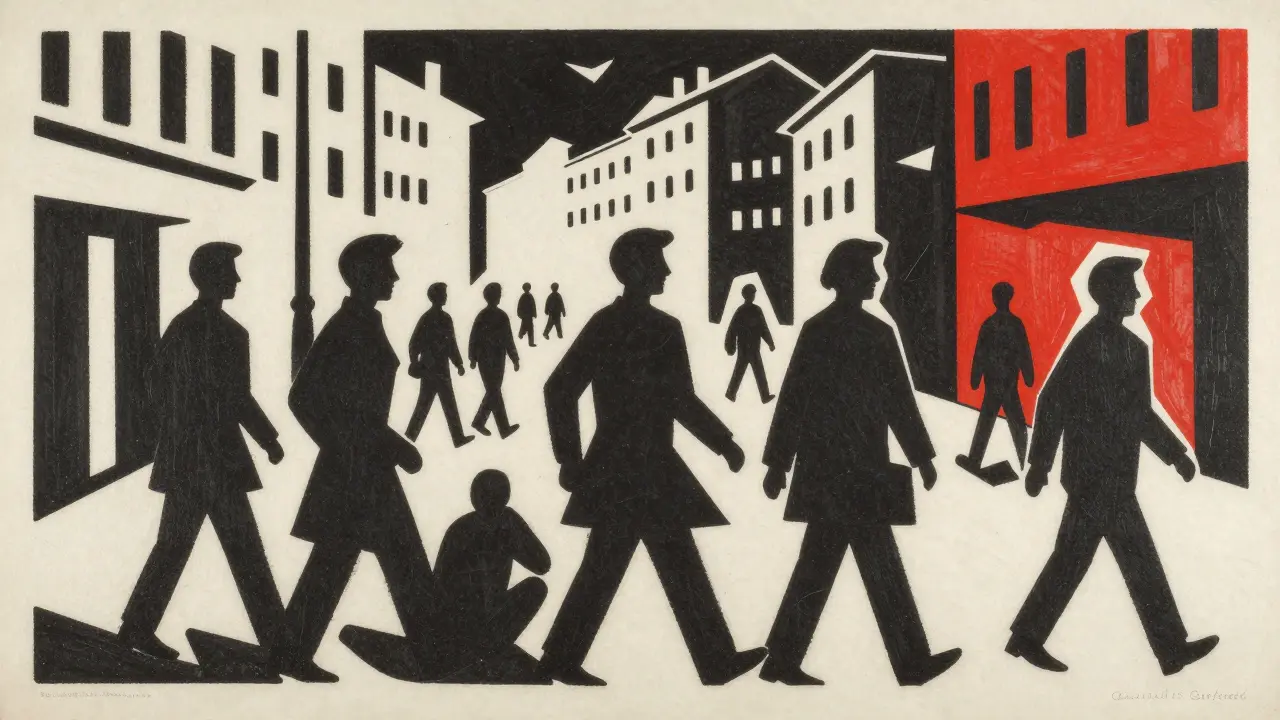
Ernst Ludwig Kirchner, the de facto leader, moved the group to Berlin in 1911. Berlin was a city exploding with energy, nightlife, and social tension. The artists captured this chaos. Their paintings featured angular figures, clashing colors, and scenes of street life that felt urgent and sometimes unsettling. They didn’t want to beautify the city; they wanted to expose its nerve endings.
One of their key techniques was woodcut printing. Woodcuts are bold, high-contrast, and inherently rough. This medium fit their aesthetic perfectly. It allowed them to create images that felt primal and direct. You can see this in works like Kirchner’s Street, Berlin, where the figures look like jagged shards of glass, reflecting the alienation of modern urban existence.
Der Blaue Reiter: Spirituality and Abstraction
While Die Brücke focused on social realism and urban angst, another group formed in Munich around 1911. Called Der Blaue Reiter (The Blue Rider), this collective included Wassily Kandinsky and Franz Marc. Their approach was less about societal critique and more about spiritual abstraction.
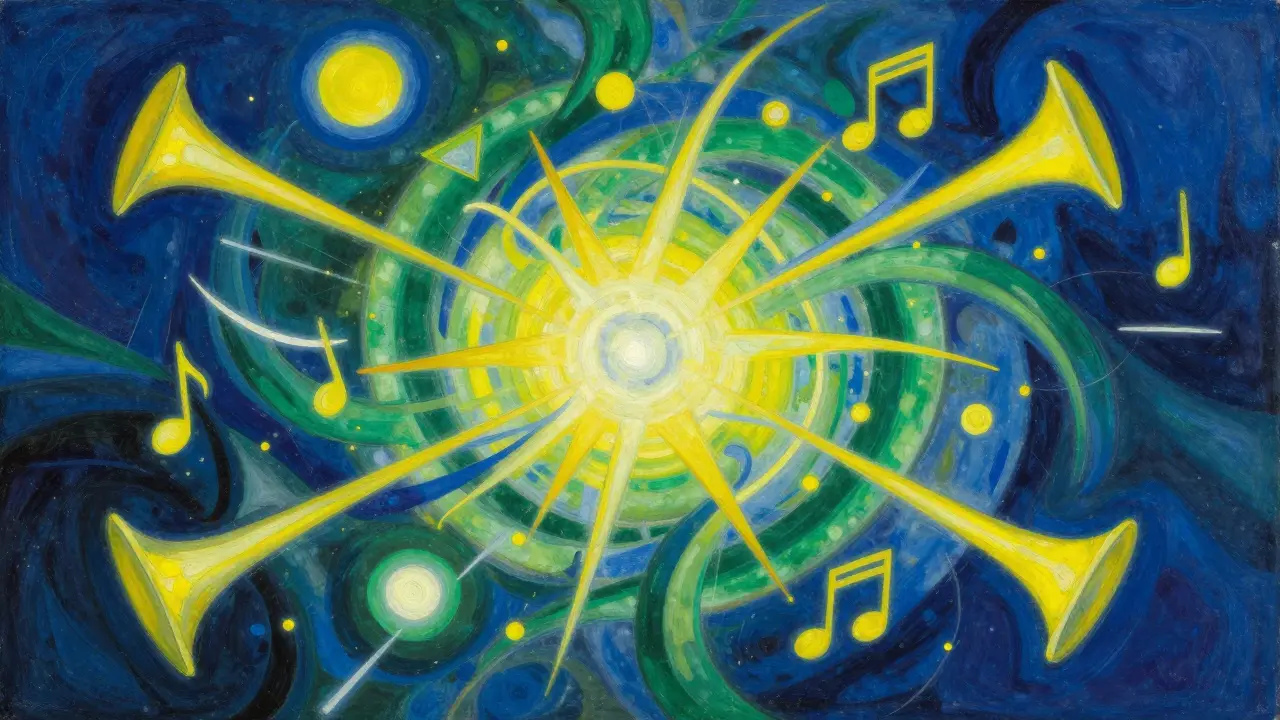
Kandinsky believed that colors and shapes had musical qualities. He argued that yellow could sound like a trumpet blast, while blue resembled a deep organ note. For Kandinsky, the goal was to create "non-objective" art-art that didn’t represent physical objects but instead evoked pure emotion through form and color alone. His work Composition VII is a chaotic symphony of lines and hues that feels like a visual explosion.
Franz Marc, on the other hand, used vivid, unnatural colors to depict animals. In his famous painting The Large Blue Horses, he stripped away the realistic brown fur of horses and replaced it with electric blues and greens. Why? Because he believed blue represented masculinity and spirituality, while green represented female calmness. He wasn’t painting horses as they appeared; he was painting their essential spirit.
| Group | Location | Key Figures | Primary Focus | Visual Style |
|---|---|---|---|---|
| Die Brücke | Dresden/Berlin | Ernst Ludwig Kirchner, Erich Heckel | Urban life, social tension, primitivism | Angular forms, harsh colors, woodcuts |
| Der Blaue Reiter | Munich | Wassily Kandinsky, Franz Marc | Spirituality, abstraction, music of color | Fluid forms, vibrant non-naturalistic colors |
Color as a Psychological Tool
If you look closely at any Expressionist work, the first thing that hits you is the color. But these aren’t decorative choices. Every hue has a job. In traditional art, color followed form. In Expressionism, form often followed color.
Consider Egon Schiele, an Austrian artist associated with Expressionism. His portraits are stark, linear, and often disturbing. He used sickly yellows and pale pinks to convey vulnerability and decay. His self-portraits, in particular, strip away vanity to reveal a raw, exposed nerve. Schiele’s use of line was equally important. He drew contours that seemed to vibrate, creating a sense of instability and tension.
Then there is Emil Nolde, who used color with almost violent intensity. He would mix paints directly on the canvas, allowing colors to bleed into each other. His religious scenes and landscapes glow with an otherworldly light. Nolde believed that color held a magical power, capable of revealing hidden truths about the world. To him, a landscape wasn’t just trees and sky; it was a battlefield of elemental forces.
Impact Beyond Painting
Expressionism wasn’t limited to canvases. It spilled over into theater, film, literature, and architecture. In cinema, German Expressionist films like The Cabinet of Dr. Caligari (1920) used distorted sets and sharp shadows to reflect the mental state of the characters. The world outside looked crazy because the characters inside were crazy. This visual language influenced horror movies for decades.
In literature, writers like Frank Wedekind and Georg Trakl used fragmented syntax and intense imagery to explore themes of madness and alienation. Poetry became less about rhyme and more about rhythm and shock. The goal was to disrupt the reader’s comfort zone, much like the painters disrupted the viewer’s expectation of beauty.
Even architecture felt the influence. Architects like Bruno Taut experimented with glass and light, creating structures that seemed to dissolve into their surroundings. The Glass Chain exhibition of 1914 showcased pavilions made entirely of glass, aiming to create a utopian, transparent society. While many of these buildings never left the drawing board, the ideas persisted in modern design.
Why Expressionism Matters Today
You might wonder why a movement from a century ago still matters. The answer is simple: we live in an age of overwhelming information and emotional complexity. Expressionism gives us a vocabulary for talking about feelings that are hard to put into words. When you see a movie with exaggerated lighting or read a poem that breaks grammatical rules, you are seeing the legacy of Expressionism.
Moreover, Expressionism challenged the idea that art must be pretty. It gave permission to artists to be messy, angry, sad, or confused. This opened the door for Abstract Expressionism in the 1940s and 50s, led by figures like Jackson Pollock and Mark Rothko. Those artists took the emotional intensity of European Expressionism and pushed it even further, removing recognizable subjects entirely.
Understanding Expressionism helps us appreciate the diversity of human experience. It reminds us that art isn’t just about decoration; it’s about communication. It’s about connecting with others on a deep, emotional level. Whether you’re looking at a painting, watching a film, or reading a book, keep an eye out for those moments where form bends to fit feeling. That’s Expressionism speaking volumes.
What is the main difference between Impressionism and Expressionism?
Impressionism focuses on capturing the immediate visual impression of a scene, particularly the effects of light and color in nature. It aims for objective observation. Expressionism, conversely, distorts reality to express subjective emotional experiences. While Impressionists paint what they see, Expressionists paint what they feel.
Who are the most famous Expressionist artists?
Key figures include Edvard Munch (known for The Scream), Ernst Ludwig Kirchner (leader of Die Brücke), Wassily Kandinsky (pioneer of abstract art), Franz Marc (known for animal paintings), Egon Schiele (for his stark portraits), and Emil Nolde (for his intense use of color).
When did the Expressionist movement begin and end?
Expressionism emerged in the early 20th century, roughly around 1905 with the founding of Die Brücke in Germany. It peaked during World War I and declined in the late 1920s and early 1930s with the rise of Nazism, which condemned it as "degenerate art." However, its influence continued through later movements like Abstract Expressionism.
Why did Expressionist artists use bright, unnatural colors?
They used unnatural colors to convey emotional states rather than physical reality. For example, blue might represent sadness or spirituality, while red could signify passion or danger. This symbolic use of color allowed artists to communicate complex feelings directly to the viewer without relying on realistic depiction.
How did World War I affect Expressionism?
World War I had a devastating impact. Many Expressionist artists served in the war, and some died. The trauma of the conflict intensified their work, leading to darker, more apocalyptic themes. After the war, the political climate in Germany shifted towards conservatism, eventually leading to the suppression of Expressionist art by the Nazi regime.