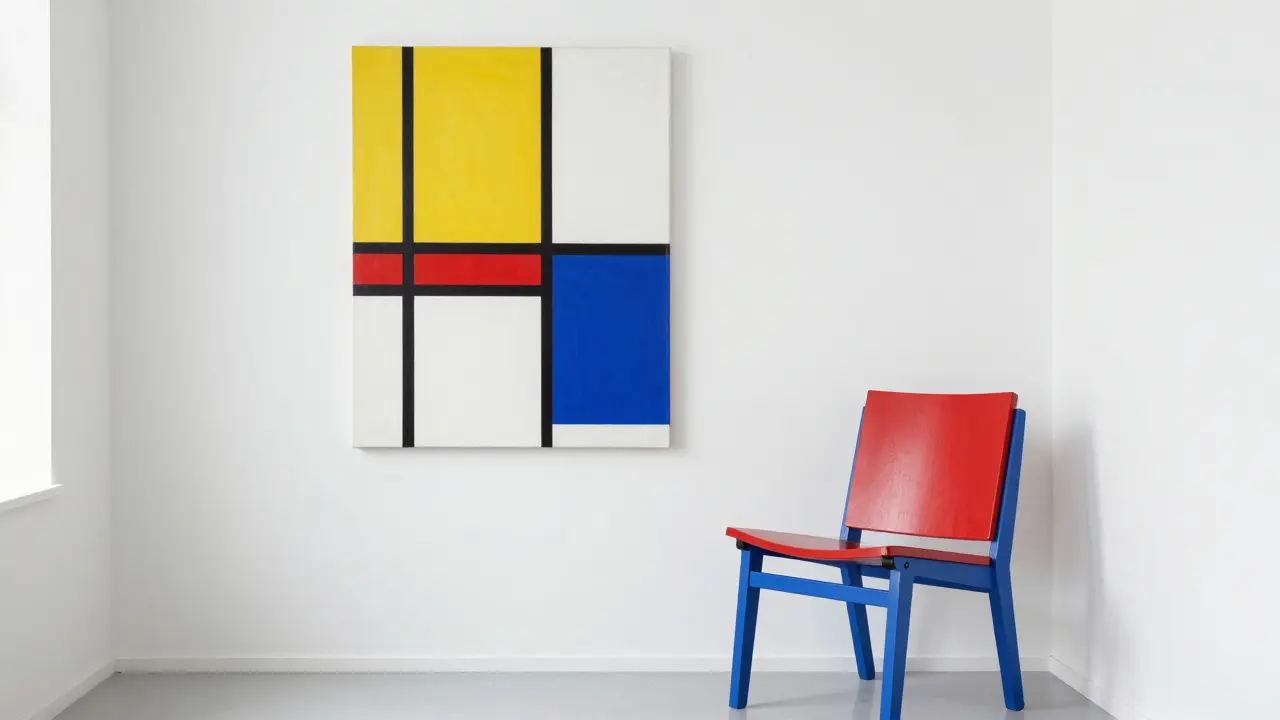
You walk into a room. The walls are white. A single chair sits in the corner, its legs painted red and blue. On the wall hangs a grid of black lines with blocks of yellow and primary colors. It feels calm. It feels precise. It feels like nothing else you’ve ever seen.
This isn’t just an art installation. This is De Stijl, a radical Dutch art movement that emerged in 1917 to strip away chaos and rebuild the world through pure abstraction. Born in the aftermath of World War I, De Stijl wasn't just about painting; it was a philosophy for living. Its members believed that by reducing art to its absolute essentials-straight lines, right angles, and primary colors-they could create a universal visual language that promoted harmony and order.
Today, we often mistake De Stijl for just "that style" with the grids and the primary colors. But looking at it only as a visual trend misses the point entirely. To understand why this movement still influences everything from your smartphone interface to skyscrapers in New York, we need to look at what these artists were actually trying to fix.
The Chaos That Sparked Order
To get why De Stijl happened, you have to look at where it started. The Netherlands in 1917 was reeling. World War I had devastated Europe, and while the Dutch remained neutral, they felt the economic and social tremors. People were tired. They were confused. The old ways of doing things seemed broken.
Theo van Doesburg, the charismatic journalist and artist who founded the De Stijl magazine and acted as the movement's chief propagandist, saw an opportunity. He didn't want art to reflect the messy, emotional reality of war. He wanted art to offer an escape from it. He gathered a group of young artists, architects, and designers who shared his frustration with traditional representation.
They rejected realism. Why paint a tree when you can paint the idea of verticality? Why sculpt a human figure when you can explore the relationship between volume and space? Van Doesburg launched the journal De Stijl (The Style) to spread their manifesto. Their goal was total unity in art. They didn't want separate disciplines for painting, architecture, or furniture. They wanted one cohesive aesthetic that governed every aspect of life.
The Visual Language: Rules of Reduction
If you want to recognize De Stijl, you don't need an art degree. You just need to know the rules. The movement imposed strict limitations on itself, believing that freedom came from discipline, not expressionism.
- Primary Colors Only: Red, yellow, and blue. No greens, no purples, no pastels. These were considered the fundamental building blocks of color.
- Achromatic Neutrals: Black, white, and gray. These provided balance and structure without adding emotional weight.
- Geometric Forms: Only straight horizontal and vertical lines. Diagonal lines were initially forbidden because they implied movement and instability.
- Asymmetry: Symmetry was seen as static and traditional. Asymmetry created dynamic equilibrium.
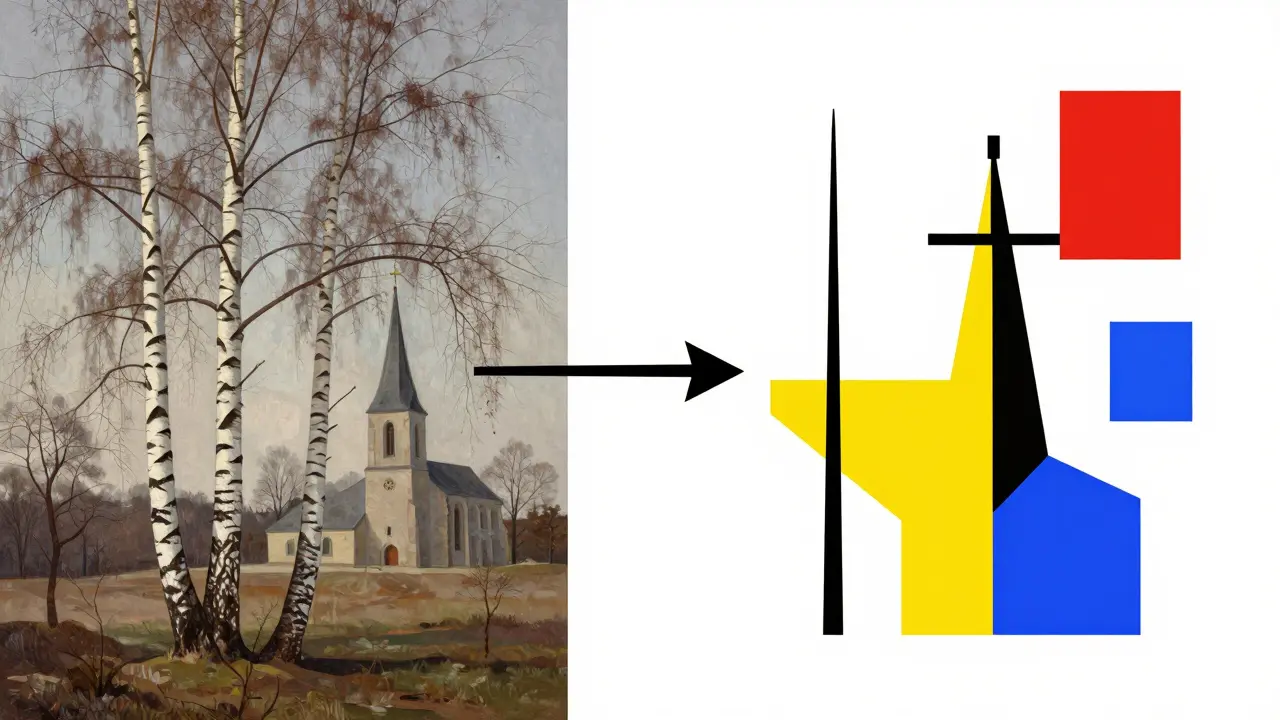
These weren't arbitrary choices. They were mathematical. The artists believed that by removing all subjective detail, they were revealing the objective truth of the universe. When you strip away the bark, the leaves, and the branches, what is left of a tree? A vertical line. De Stijl sought to paint that essence.
Piet Mondrian and the Evolution of the Grid
No discussion of De Stijl is complete without Piet Mondrian, the most famous practitioner of the movement, known for his iconic grid paintings composed of black lines and primary color rectangles. Before he joined De Stijl, Mondrian was painting landscapes. Birch trees, church towers, dunes. But he kept simplifying them.
By 1917, Mondrian had arrived at his mature style. His paintings looked less like pictures and more like architectural plans. He used thick black lines to divide the canvas into rectangular sections. Some sections were filled with solid red, yellow, or blue. Others were left white. The key was balance. If you added a large block of red, you needed a corresponding area of empty space or a smaller block of blue to counterweight it visually.
Mondrian called this "Neoplasticism." He believed that art should not represent nature but should exist alongside it as an independent, spiritual force. His work wasn't cold or robotic, as critics sometimes claimed. It was deeply spiritual. He was searching for a universal harmony that transcended individual culture or time period. In a world tearing itself apart, Mondrian offered a quiet, balanced alternative.
Beyond the Canvas: Architecture and Furniture
While Mondrian stayed mostly within painting, other members of De Stijl pushed the movement into three dimensions. This is where De Stijl became truly revolutionary. They didn't just want pretty pictures; they wanted to build a new society.
Gerrit Rietveld, a cabinetmaker turned architect who translated De Stijl principles into physical objects, most notably the Red Blue Chair, created the most famous piece of furniture associated with the movement. The Red Blue Chair, designed in 1917 and finished in 1918, looks like a Mondrian painting exploded into 3D space. It consists of wooden slats arranged in orthogonal planes. The joints are exposed. The surfaces are painted in primary colors and black. It’s uncomfortable to sit in, but it’s impossible to ignore.
Rietveld took this further with the Rietveld Schröder House in Utrecht, completed in 1924. This house is the ultimate expression of De Stijl architecture. The interior features sliding walls that can open up entire floors, blurring the line between rooms. The exterior is a flat white cube punctuated by colorful horizontal and vertical elements. There are no decorative moldings, no ornate cornices. Just pure form and function. Today, it’s a UNESCO World Heritage site, recognized not just as a house, but as a manifesto in brick and mortar.
The Split: Diagonals and Conflict
Utopian movements rarely survive intact, and De Stijl was no exception. The tension began with one simple question: What about diagonal lines?
Van Doesburg grew restless with the strict horizontality and verticality. He introduced "Elementarism," which allowed diagonal lines to add dynamism and energy to compositions. For him, diagonals represented movement and progress. For Mondrian, they represented chaos and a return to naturalistic forms. Mondrian believed that introducing diagonals compromised the purity of the movement.
The disagreement wasn't just artistic; it was personal. Van Doesburg published works under the name "Vantool" to mock Mondrian’s rigidity. Eventually, Mondrian left the group. This split marked the beginning of the end for De Stijl as a unified organization. Van Doesburg continued to promote his version of the style, but the core cohesion was gone. By 1931, after Van Doesburg’s death, the movement effectively dissolved.

Why De Stijl Still Matters Today
You might wonder why a short-lived Dutch art group from the 1920s matters now. Look around you. De Stijl didn't disappear; it went mainstream.
The influence of De Stijl is everywhere in modern design. Think about the clean lines of Apple products. Think about the grid-based layouts of websites and magazines. Think about the minimalist architecture of cities like Dubai or Shanghai. All of this traces back to the idea that simplicity is clarity.
In graphic design, the use of sans-serif fonts, ample white space, and bold primary accents owes a debt to De Stijl. In fashion, designers like Yves Saint Laurent and Paul Smith have explicitly referenced Mondrian’s grids in their collections. Even in music, the structured minimalism of composers like John Cage echoes the same desire for order and reduction.
But perhaps the most important legacy of De Stijl is its approach to problem-solving. The movement teaches us that constraints can be liberating. When you remove the noise-the unnecessary details, the decorative excesses-you’re forced to focus on what truly matters. In a world saturated with information and visual clutter, that lesson is more relevant than ever.
| Name | Role | Key Contribution |
|---|---|---|
| Theo van Doesburg | Founder / Writer | Launched the journal De Stijl; introduced Elementarism (diagonals) |
| Piet Mondrian | Painter | Developed Neoplasticism; created iconic grid paintings |
| Gerrit Rietveld | Architect / Designer | Designed the Red Blue Chair and Rietveld Schröder House |
| Bart van der Leck | Painter | Influenced Mondrian’s use of primary colors before joining De Stijl |
| Gus van de Woestijne | Writer / Critic | Provided theoretical support for the movement’s philosophical goals |
Frequently Asked Questions
What exactly is De Stijl?
De Stijl is a Dutch art and design movement founded in 1917 by Theo van Doesburg. It focused on pure abstraction and reductionism, limiting shapes to squares and rectangles, and colors to primary hues plus black and white. The goal was to create a universal visual language that promoted harmony and order in post-war society.
Who was the most famous artist in De Stijl?
Piet Mondrian is the most widely recognized figure associated with De Stijl. His grid paintings, featuring black lines and blocks of primary color, have become iconic symbols of modernist art and are instantly recognizable worldwide.
Why did De Stijl use only primary colors?
The movement believed that red, yellow, and blue were the fundamental building blocks of all other colors. By using only these primaries, along with black, white, and gray, artists aimed to strip away subjective emotion and reveal the objective, universal truths of visual composition.
How did De Stijl influence modern architecture?
De Stijl emphasized functionalism, geometric simplicity, and the elimination of ornamentation. Architects like Gerrit Rietveld applied these principles to buildings such as the Rietveld Schröder House, influencing later modernist movements like Bauhaus and International Style, which prioritize clean lines and open spaces.
What caused the split in De Stijl?
The main conflict arose over the use of diagonal lines. Theo van Doesburg advocated for diagonals to add dynamism (Elementarism), while Piet Mondrian insisted on strict horizontal and vertical lines to maintain purity and balance (Neoplasticism). This ideological difference led to Mondrian leaving the group.
Is De Stijl related to Cubism?
Yes, indirectly. Early De Stijl artists were influenced by Cubism, particularly in its fragmentation of form. However, De Stijl moved beyond Cubism by eliminating any reference to natural forms entirely, aiming for pure abstraction rather than depicting objects from multiple angles.
Where can I see original De Stijl works today?
Major museums like the Museum Boijmans Van Beuningen in Rotterdam, the Kröller-Müller Museum in Otterlo, and the Stedelijk Museum in Amsterdam hold significant De Stijl collections. The Rietveld Schröder House in Utrecht is also open to the public as a UNESCO World Heritage site.