Key Takeaways
- Cubism broke objects into geometric shapes to show multiple viewpoints at once.
- It evolved from the structural experiments of Paul Cézanne.
- Analytical Cubism focused on breaking things down; Synthetic Cubism focused on building them up.
- The movement paved the way for almost every abstract art style that followed.
The Spark That Started the Fire
Cubism didn't just appear out of thin air. It was born from a restlessness in Paris around 1907. Pablo Picasso is a Spanish painter and sculptor who co-founded the Cubist movement. Alongside him was Georges Braque, a French artist who shared his obsession with rearranging space. They weren't just playing with shapes; they were responding to a world that was moving faster. Think about it: the early 1900s brought cars, airplanes, and cinema. The world was no longer static, so why should art be?
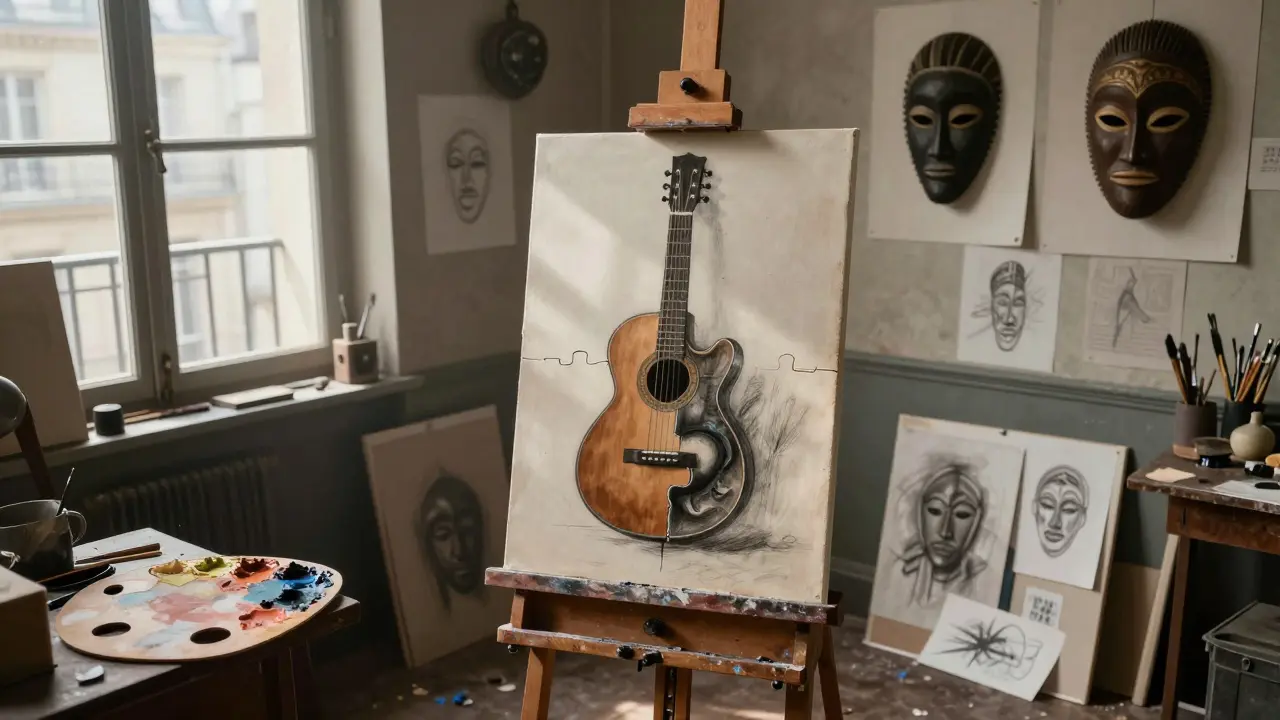
They both looked at Paul Cézanne, who had started treating nature as a collection of cylinders, spheres, and cones. While most artists were still painting pretty landscapes, Cézanne was essentially "prototyping" Cubism. He taught Picasso and Braque that you could tilt a tabletop or warp a vase to make the composition feel more stable and honest. When Picasso painted Les Demoiselles d'Avignon in 1907, he blew the doors open. He didn't just paint women; he painted jagged, fractured forms influenced by African masks, stripping away the "beauty" of the Renaissance to find a raw, structural truth.
Analytical Cubism: Breaking the World Apart
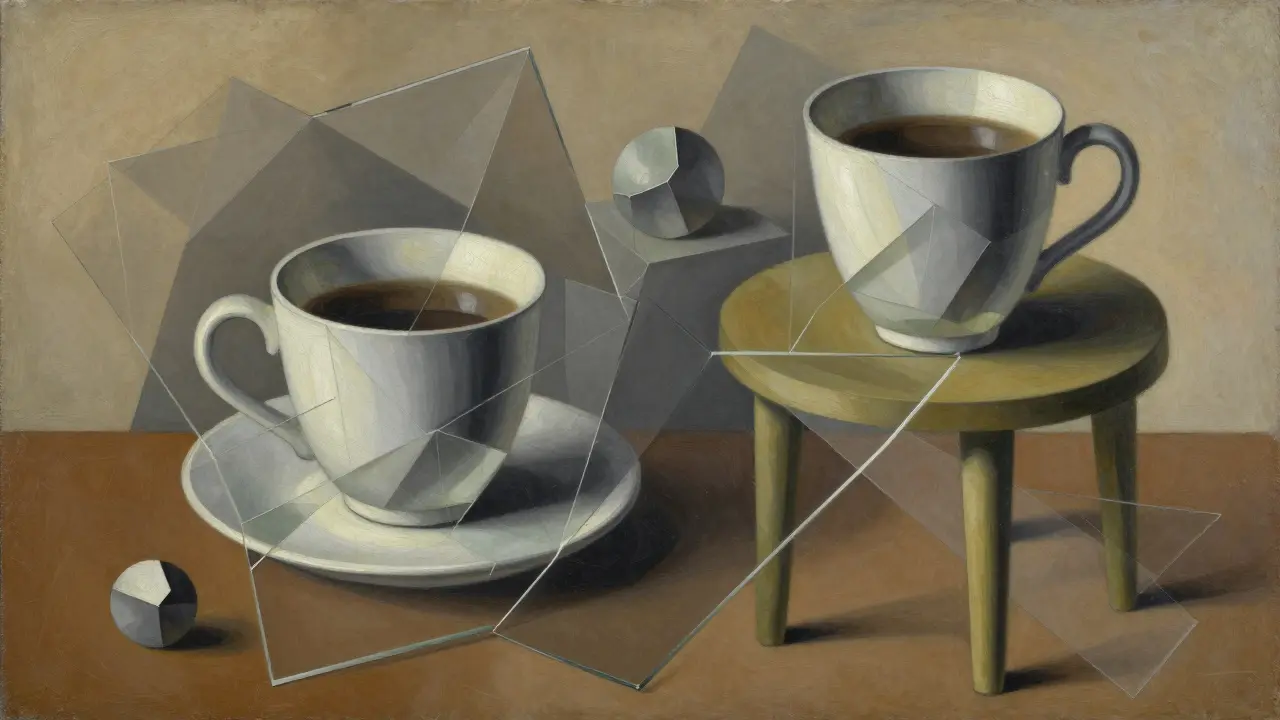
Between 1908 and 1912, the movement entered its first major phase: Analytical Cubism. The goal here was a clinical dissection of the subject. If you were painting a coffee cup, you wouldn't just paint the rim; you'd paint the bottom, the handle, and the shadow all overlapping. The colors became muted-mostly browns, greys, and ochres. Why? Because bright colors distract from the structure. They wanted the viewer to focus on the geometry, not the mood.
This period is where art becomes an intellectual exercise. You have to actively participate in the painting to "reassemble" the image in your mind. It's like looking at a shattered mirror; you see the fragments of the object, but you know they belong together. Braque and Picasso became so similar in their style during this time that some of their paintings from 1911 are almost impossible to tell apart. They were working in a shared laboratory, stripping art down to its barest essentials.
| Feature | Analytical Cubism | Synthetic Cubism |
|---|---|---|
| Primary Goal | Deconstruction and Analysis | Construction and Synthesis |
| Color Palette | Muted (Browns, Greys, Black) | Bright and Varied |
| Materials | Oil on Canvas | Mixed Media, Collage, Found Objects |
| Visual Feel | Complex, Fractured, Dense | Flat, Playful, Simplified |
Synthetic Cubism: Putting the Pieces Back Together
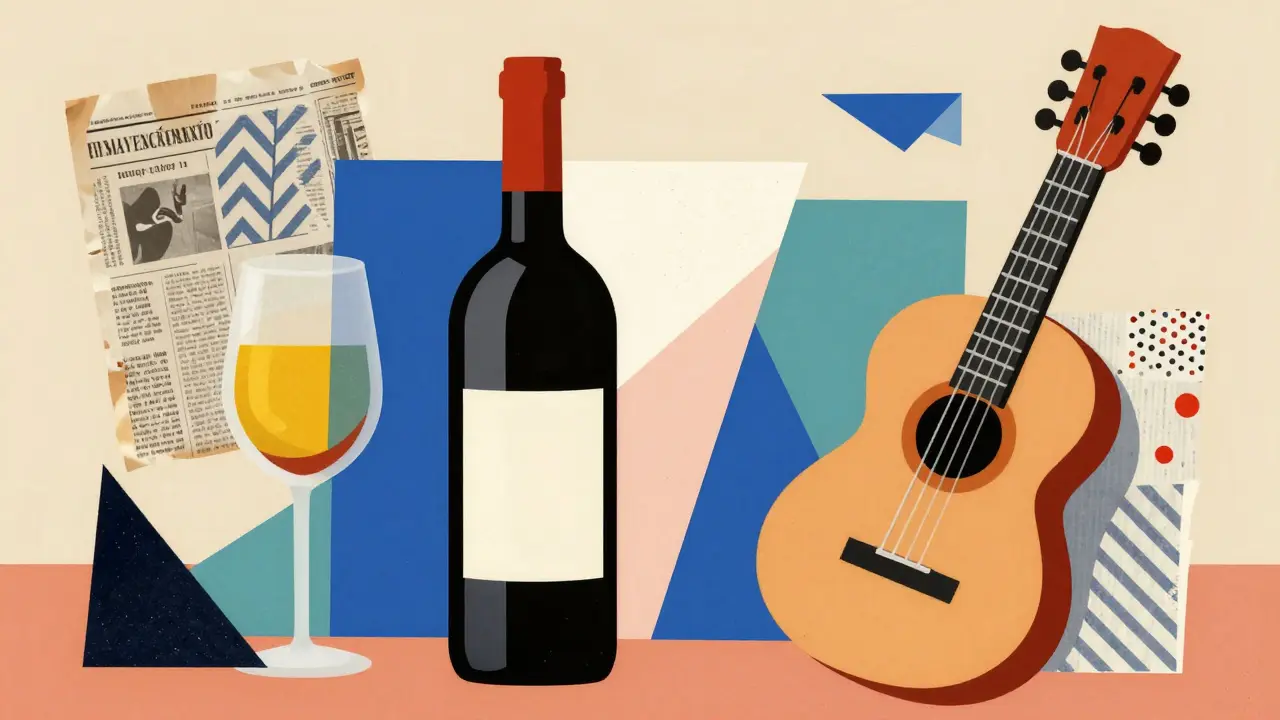
By 1912, the artists realized they had pushed the "breaking down" process so far that their art was becoming almost completely abstract. People couldn't tell a guitar from a bottle of wine. To fix this, they shifted into Synthetic Cubism. Instead of analyzing an object by breaking it, they "synthesized" it by building it up from different elements. This is where the invention of Collage comes in.
Picasso started gluing pieces of oilcloth, newspaper, and wallpaper directly onto the canvas. This was a radical move. For centuries, painting was about imitating reality. By gluing a real piece of newspaper onto a painting, Picasso was saying, "Why pretend to paint a newspaper when I can just put one here?" It blurred the line between the real world and the painted world. The shapes became larger, flatter, and more colorful. It felt less like a science experiment and more like a visual game.
The Ripple Effect on Modern Art
Cubism didn't stop with painting. It leaked into everything. It influenced Futurism in Italy, where artists added a sense of speed and violence to the Cubist style. Imagine a Cubist painting of a dog, but then you add twenty legs to show it's running-that's Futurism. It also laid the groundwork for Constructivism in Russia, which took the geometric focus of Cubism and applied it to architecture and political propaganda.
Even if you aren't an art historian, you see the fingerprints of Cubism every day. Every time you see a stylized logo, a simplified architectural blueprint, or a modern graphic design that uses overlapping transparent shapes, you're seeing a descendant of what Picasso and Braque started in those dusty Parisian studios. They gave artists permission to stop lying about perspective and start experimenting with the actual essence of a form.
Common Pitfalls When Viewing Cubism
Many people look at a Cubist piece and think, "My kid could do that," or "It's just a mess." The mistake is trying to find a "correct" angle to view the painting. In a traditional portrait, there is one focal point. In Cubism, the focal point is everywhere. If you struggle to "get" it, try this: stop looking for the object and start looking for the rhythm. Look at how the lines lead your eye from one corner to another. The goal isn't to recognize a face; it's to experience the idea of a face from every possible angle at once.
Was Cubism just about making things look like cubes?
Not exactly. While the name suggests cubes, the movement was more about "geometricity." It used spheres, cones, and cylinders to simplify complex forms. The "cube" part of the name actually came from a critic who mocked Braque's paintings for looking like they were made of little cubes.
Why did they stop using bright colors in Analytical Cubism?
Picasso and Braque wanted to focus on the structure and the volume of the objects. They felt that vibrant colors were too emotional and would distract the viewer from the intellectual challenge of understanding the fragmented space.
What is the difference between a collage and a painting?
A painting uses pigment to represent a surface. A collage, which became central to Synthetic Cubism, incorporates actual physical materials-like sand, newspaper, or fabric-into the work. This brings a tactile, three-dimensional reality to a two-dimensional surface.
Did Cubism influence architecture?
Yes, immensely. The movement's focus on interlocking planes and geometric simplification influenced the Bauhaus school in Germany and the works of architects like Le Corbusier, who favored clean lines and functional, geometric volumes over ornate decoration.
How can I tell if a painting is Analytical or Synthetic?
Look at the colors and the materials. If it's mostly brown/grey, looks very "shattered," and is purely paint, it's likely Analytical. If it has bright colors, flat shapes, and looks like it has pieces of paper or fabric glued to it, it's Synthetic.
What to Explore Next
If you're fascinated by how Cubism broke the rules, you might want to look into Surrealism. While Cubism played with the physical structure of the world, Surrealism played with the psychological structure of the mind. Both movements share a love for distorting reality, but one does it with a ruler and the other does it with a dream. Alternatively, diving into the works of Piet Mondrian will show you how Cubism eventually evolved into a completely abstract style of grids and primary colors.