
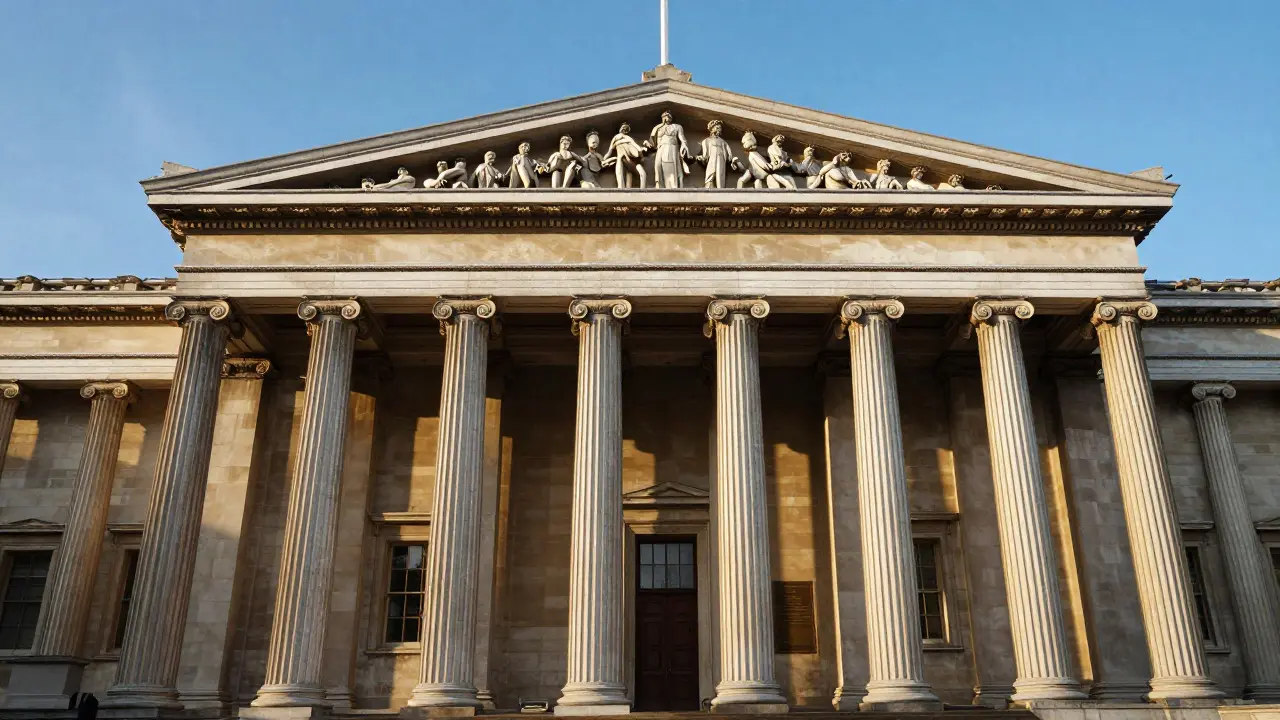
Walk past the United States Capitol, which is the meeting place of the United States Congress featuring a massive dome inspired by the Pantheon or the British Museum in London. What do you feel? It’s not just size that hits you. It’s a sense of permanence. A feeling that these buildings were built to last forever. That specific weightiness comes from Classicism in Architecture, which is a style based on the principles of ancient Greek and Roman design emphasizing order, symmetry, and proportion.
We often think of "classic" as something old-fashioned or dusty. But in architecture, classicism isn’t about being stuck in the past. It is a toolkit for creating clarity. When modern life feels chaotic, our brains crave structure. Classicism provides that structure through strict rules of geometry and balance. It asks us to look at a building not just as a shelter, but as a mathematical expression of harmony.
The DNA of Classical Design
To understand why this style has survived for two thousand years, we have to look at its core ingredients. You cannot fake classicism. If you get the proportions wrong, it looks like a costume rather than a statement. There are three non-negotiable pillars here.
First is symmetry. Imagine drawing a line down the center of the façade. The left side should mirror the right side almost perfectly. This isn’t just aesthetic; it signals stability. In nature, asymmetry often means damage or decay. In architecture, symmetry signals health and order.
Second is proportion. Ancient builders didn't guess how wide a column should be relative to its height. They used ratios derived from the human body. The Vitruvian Man, which is a famous drawing by Leonardo da Vinci illustrating ideal human proportions based on texts by Vitruvius captures this idea. If a room feels "off," it’s usually because the ratio of width to height violates these golden standards. A common rule of thumb is the Golden Ratio (1:1.618), though classical architects often used simpler integer ratios like 2:3 or 3:4 for ease of construction.
Third is detailing. Every element serves a purpose, even if that purpose is purely visual. Moldings, cornices, and pediments aren’t random decorations. They frame the space and guide your eye. Without them, a building looks flat. With them, it gains depth and hierarchy.
The Five Orders: Your Architectural Alphabet
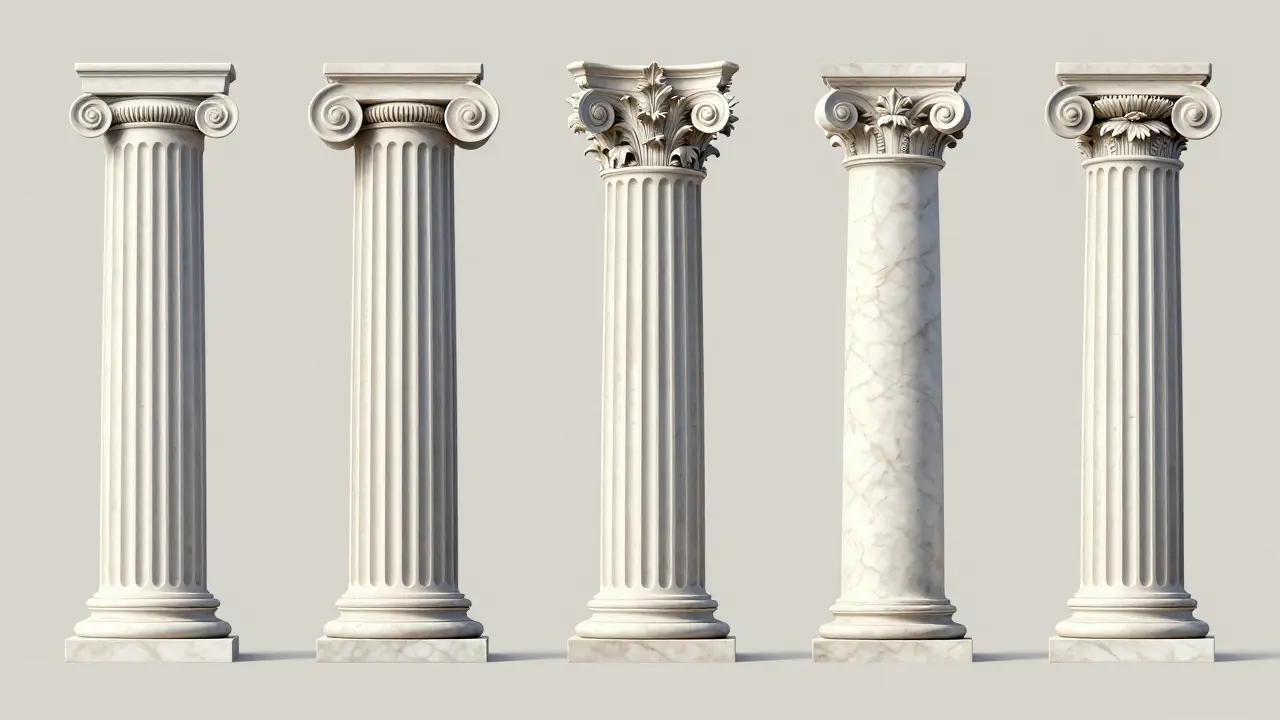
If you want to speak the language of classicism, you need to know the alphabet. That alphabet consists of the five classical orders. These are systems for designing columns and their supporting structures. Each order has a distinct personality and set of rules.
| Order | Origin | Capital Style | Fluting | Personality/Vibe |
|---|---|---|---|---|
| Doric | Greek | Plain, square abacus | 20 flutes, sharp edges | Masculine, sturdy, austere |
| Ionic | Greek | Spiral volutes (scrolls) | 24 flutes, rounded edges | Elegant, intellectual, balanced |
| Corinthian | Greek/Roman | Acanthus leaves | 24 flutes, shallow | Ornate, luxurious, dramatic |
| Tuscan | Roman | Simple, plain | None (smooth shaft) | Robust, simple, military |
| Composite | Roman | Volutes + Acanthus leaves | 24 flutes | Grand, imperial, complex |
Notice how the Greeks invented the first three, while the Romans added the Tuscan and Composite. The Romans loved excess. They took the Ionic scrolls and Corinthian leaves and smashed them together to create the Composite order. You see this most often in government buildings where the message needs to be "we are powerful and sophisticated."
When you visit the Pantheon, which is a former Roman temple in Rome dedicated to all the gods of ancient Rome, known for its massive unreinforced concrete dome, you see the Corinthian order in action. The grandeur of the interior matches the ornate capitals outside. Contrast that with the Parthenon, which is a former temple on the Athenian Acropolis dedicated to the goddess Athena, constructed in the mid-5th century BC. The Doric columns there feel heavy and grounded. They don’t try to impress you with tricks; they impress you with sheer mass and precision.
From Antiquity to the Enlightenment
Classicism didn’t die when the Roman Empire fell. It went underground, adapted into Gothic styles, and then exploded back into the mainstream during the Renaissance. Architects like Andrea Palladio, who was an Italian architect during the High Renaissance widely regarded as one of the most influential figures in Western architecture wrote books that became the bible for future generations. His villas in the Veneto region of Italy are masterclasses in applying classical rules to private homes.
Then came the Neoclassical movement in the 18th and 19th centuries. Why did it happen? Because people got tired of Baroque and Rococo styles, which were full of curves, gold leaf, and chaos. The discovery of Pompeii and Herculaneum gave architects fresh examples of pure Roman design. Suddenly, straight lines and white marble were cool again.
This revival wasn’t just artistic; it was political. New nations wanted to signal their legitimacy. The United States, France, and Russia all adopted Neoclassicism for their capital cities. They wanted to say, "We are the heirs to Rome. We value democracy, law, and reason." That is why so many courthouses and banks look like temples. They are borrowing the authority of antiquity to lend weight to modern institutions.
Why Classicism Still Matters Today
You might think that in an age of glass skyscrapers and parametric design, classicism is obsolete. I disagree. Look at the trend of "New Classical" architecture. Cities like London, Washington D.C., and Paris have strict guidelines that require new buildings to respect the classical context. Why? Because humans respond biologically to these forms.
Research in environmental psychology suggests that symmetrical environments reduce stress. When you walk into a room with balanced proportions, your brain processes it faster. It doesn’t have to work hard to figure out what’s going on. This cognitive ease translates to feelings of trust and calm. For hospitals, schools, and libraries, this is a functional benefit, not just a stylistic choice.
Furthermore, classicism teaches sustainability through longevity. A well-built classical facade using stone or brick can last centuries with minimal maintenance. Compare that to the cladding on many modern curtain-wall buildings, which often fails within 30 years. Classicism prioritizes material honesty. Stone looks like stone. Wood looks like wood. There is no pretense.
Common Mistakes to Avoid
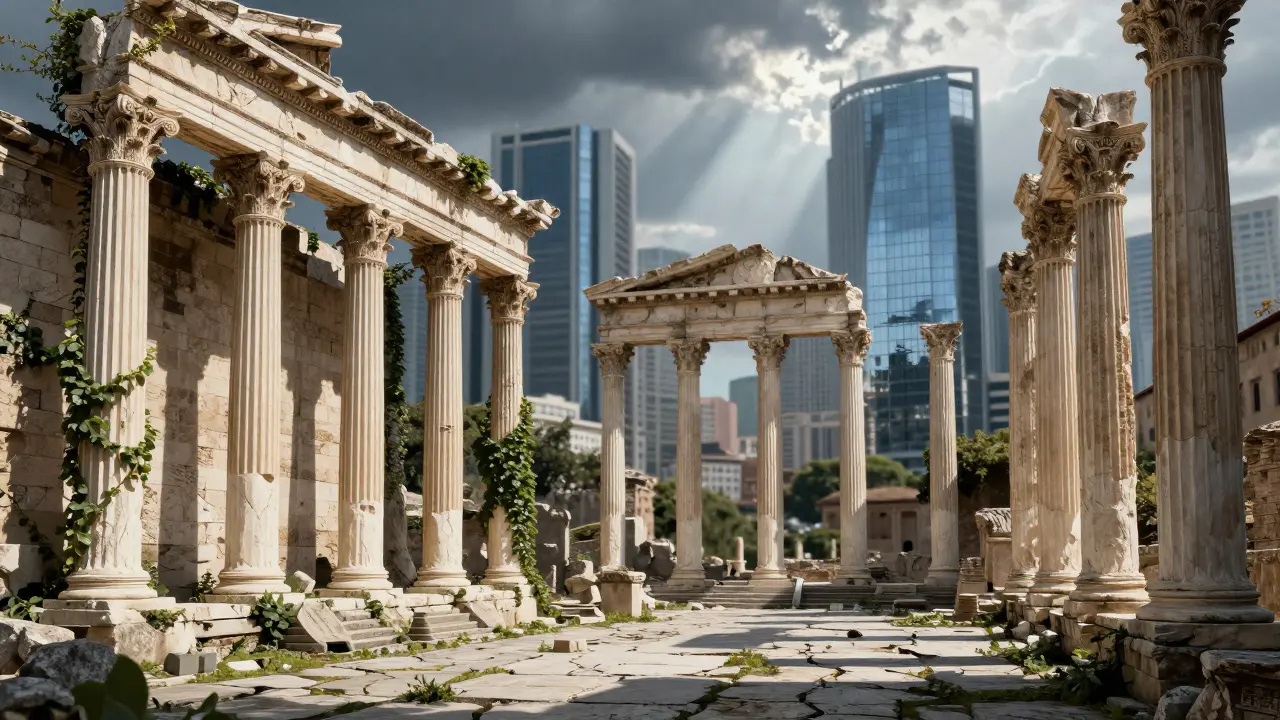
If you are trying to incorporate classical elements into a project, whether it’s a home renovation or a public plaza, beware of "kitsch." Kitsch happens when you slap a column on a wall without understanding the structural logic behind it. Here is how to avoid looking like a theme park:
- Don’t mix orders randomly. Stick to one order per façade unless you have a very strong reason to transition between them. Mixing Doric and Corinthian haphazardly creates visual noise.
- Respect the scale. Classical elements have standard dimensions. A column that is too thin looks fragile; one that is too thick looks clumsy. Use the canonical ratios found in treatises by Vitruvius or Palladio.
- Focus on the base and capital. These are the bookends of the column. If the shaft is perfect but the capital is poorly detailed, the whole system fails. The capital carries the visual weight of the entablature above it.
- Use real materials. Fiberglass columns can look convincing from 50 feet away, but up close, they betray themselves. Real stone, cast iron, or high-quality concrete casting adds the necessary texture and shadow lines.
Frequently Asked Questions
What is the difference between Neoclassical and Classical architecture?
Classical architecture refers to the original buildings from ancient Greece and Rome (roughly 800 BC to 400 AD). Neoclassical architecture is a revival style that emerged in the mid-18th century. While Neoclassicism borrows heavily from classical forms-using columns, domes, and pediments-it often simplifies details and applies them to modern building types like museums and government offices. Think of Classical as the original manuscript and Neoclassical as the modern reprint.
Why do banks and courthouses use classical architecture?
These institutions rely on public trust and authority. Classical architecture, particularly the Greek and Roman styles, is historically associated with democracy, law, and stability. By using features like grand porticos and heavy stone facades, these buildings subconsciously communicate permanence and reliability to visitors. It is a psychological strategy to reinforce the seriousness of the functions performed inside.
Can classical architecture be sustainable?
Yes, classical architecture promotes sustainability through durability and passive design. Traditional classical buildings often feature thick masonry walls that provide thermal mass, helping to regulate indoor temperatures naturally. Additionally, the emphasis on long-lasting materials like stone and brick reduces the need for frequent repairs and replacements, lowering the lifecycle carbon footprint compared to disposable modern materials.
What is the Golden Ratio in classical architecture?
The Golden Ratio is a mathematical proportion approximately equal to 1:1.618. It appears frequently in nature and was highly valued by ancient Greek architects. In classical design, it is used to determine the proportions of rooms, facades, and individual elements like windows and doors. Buildings that adhere to this ratio are often perceived as more aesthetically pleasing and harmonious to the human eye.
How do I identify the different classical orders?
Look at the capital (the top part) of the column. Doric columns have a simple, plain square capital. Ionic columns feature distinctive spiral scrolls called volutes. Corinthian columns are decorated with intricate carvings of acanthus leaves. Tuscan columns are smooth and unadorned, similar to Doric but simpler. Composite columns combine the scrolls of Ionic with the leaves of Corinthian. The fluting (vertical grooves) on the shaft also varies in number and depth between orders.