When you walk into a room with gilded mirrors, pastel walls, and curves that seem to dance off the walls, you’re not just seeing decor-you’re stepping into Rococo. It’s not just a style from the 1700s. It’s alive. Right now. In your favorite boutique hotel, in the latest Chanel runway show, in the wallpaper you scrolled past on Instagram. Rococo didn’t fade. It evolved.
What Rococo Really Was
Rococo began in France around 1720, right after the heavy, dramatic Baroque era. Where Baroque shouted power and religion with marble columns and dark gold, Rococo whispered intimacy. It was made for salons, boudoirs, and private gardens-not cathedrals or palaces of kings. Think less Louis XIV, more Marie Antoinette’s private retreat at Petit Trianon.
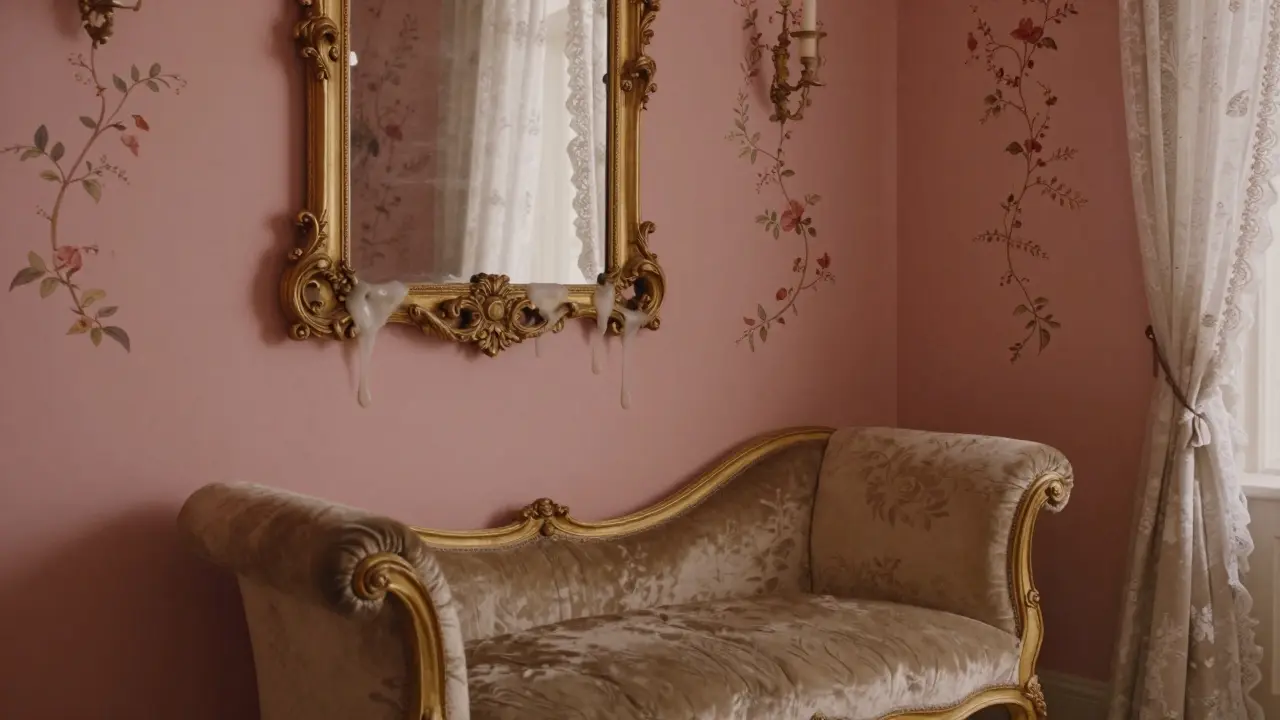
The word itself comes from the French rocaille, meaning rockwork or shellwork. Artists used seashells, scrolls, and twisted vines as building blocks. They painted flowers that looked like they were growing out of the walls. Ceilings curved like waves. Furniture had legs shaped like clawed feet, and mirrors were framed in gold that looked like melted candy.
It wasn’t just decoration. It was emotion. Rococo was about pleasure, playfulness, and delicate beauty. It captured the feeling of a summer afternoon-light, soft, and fleeting.
Why It Fell Out of Favor
By the 1770s, people started calling Rococo frivolous. The French Revolution was coming. The aristocracy was drowning in lace and sugar-coated art while peasants starved. The new wave-Neoclassicism-came in like a cold shower. Straight lines. Marble. Roman columns. No more curling vines.
Rococo got labeled as decadent. Outdated. Too feminine. Too much.
But here’s the twist: the very things people hated about it are what make it powerful today.
The Modern Rococo Resurgence
In 2024, a study by the Design Futures Council found that 68% of interior designers under 35 had used Rococo-inspired elements in at least one project. Not as a pastiche. Not as a joke. As a legitimate language.
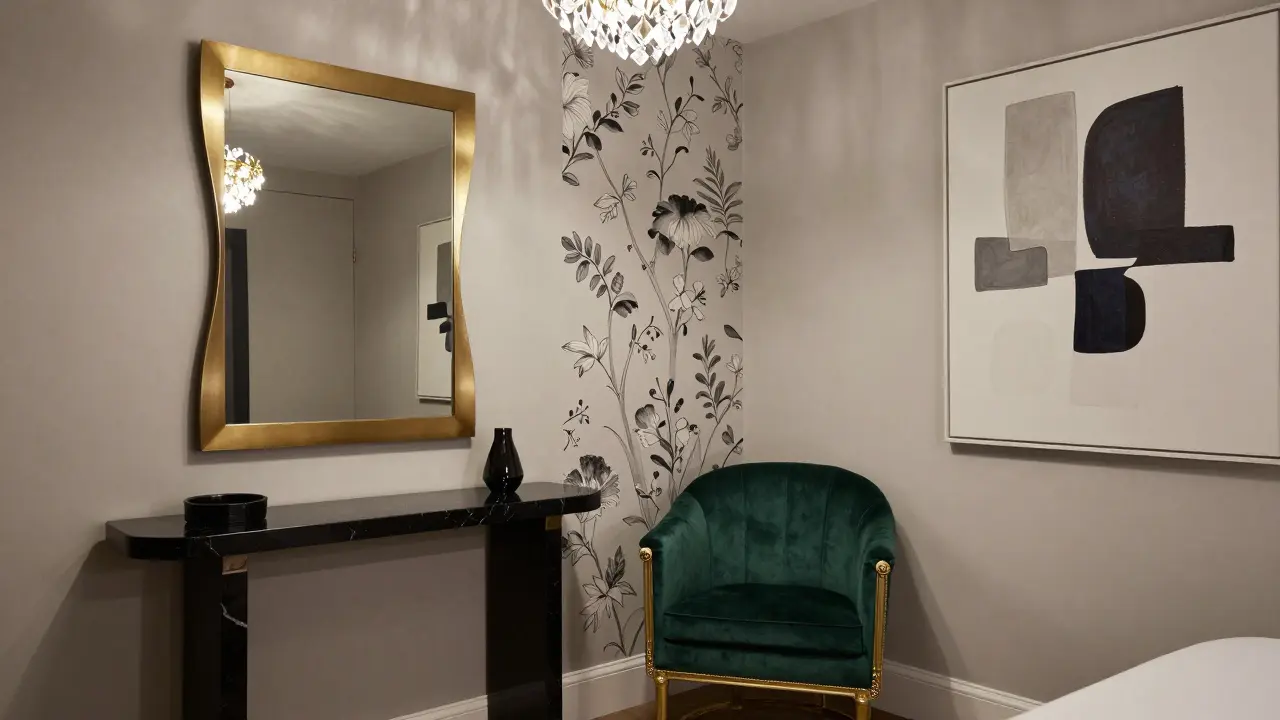
Look at the interiors of The NoMad Hotel in New York. The velvet sofas, the gold leaf accents, the floral damasks-all nod to 18th-century France, but they’re paired with minimalist lighting and modern art. It’s not copying. It’s remixing.
Designers like India Mahdavi and Kelly Wearstler don’t recreate Rococo. They borrow its soul: the love of texture, the joy of asymmetry, the refusal to be boring. A curved armchair isn’t just furniture-it’s a statement. A wall covered in hand-painted vines isn’t wallpaper-it’s a mood.
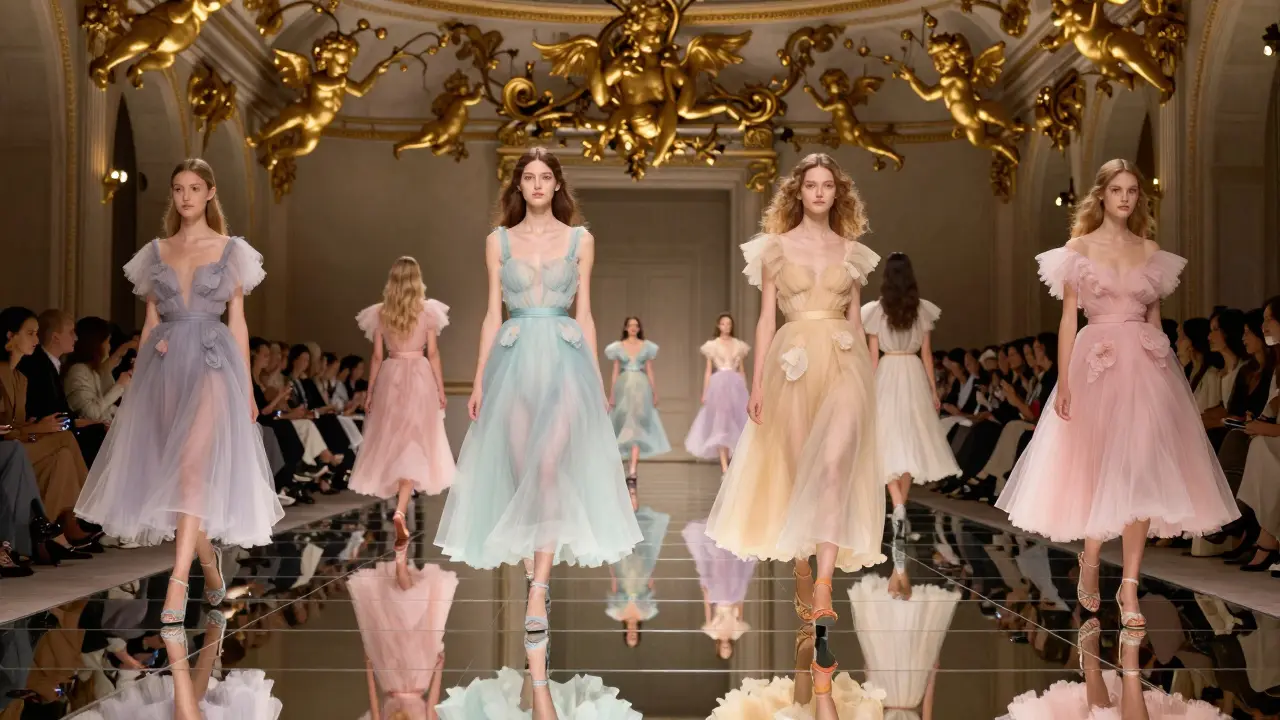
Even fashion picked it up. In 2023, Dior’s spring collection featured gowns with embroidered cherry blossoms and silk ribbons that dripped like melted sugar. Gucci’s 2025 show had mirrors embedded in the runway floor, reflecting models in pastel taffeta as if they were floating in a Rococo salon.
Key Elements That Still Work Today
You don’t need a palace to use Rococo. You just need to understand what makes it tick. Here’s what still holds up:
- Curves over straight lines-Even in minimal spaces, a single curved mirror or arched doorway adds softness.
- Gold, but not gaudy-Brushed gold, not mirror-polished. Think antique brass, not disco ball.
- Handmade textures-Rococo wasn’t mass-produced. Today, that means hand-painted tiles, woven rattan, or ceramic knobs with imperfections.
- Color that feels like a dream-Powder blue, blush pink, mint green, lavender. Not neon. Not pastel from a children’s toy store. Think faded silk.
- Asymmetry as art-One large mirror on one wall, two small ones on the other. A single vase on a shelf, nothing else. It’s not messy. It’s intentional.
These aren’t rules. They’re invitations. Rococo doesn’t demand full commitment. It rewards subtle touches.
Rococo vs. Baroque: The Real Difference
People mix them up. They’re not the same.
Baroque is loud. It’s meant to overwhelm. Think of St. Peter’s Basilica in Rome-huge, heavy, meant to make you feel small before God. It uses symmetry, deep shadows, and dramatic lighting.
Rococo is quiet. It’s meant to draw you in. A small boudoir in Versailles, lit by candlelight, with a single painting of lovers in a garden. No grandeur. Just tenderness.
Baroque says, “Look at me.” Rococo says, “Come closer.”
That’s why Rococo feels more personal today. In a world of algorithms and noise, we crave spaces that feel intimate, not imposing.
Where to Find Rococo Today-Beyond the Museums
You don’t need to travel to Paris to feel it.
In Tokyo, the café La Chambre des Fleurs uses hand-painted floral wallpaper and curved wooden benches. In Los Angeles, a boutique called Velvet & Vine sells lamps with porcelain petals and brass stems. Even Airbnb listings now tag properties as “Rococo-inspired” when they have gilded frames, silk curtains, or clawfoot tubs with ornate taps.
It’s not about authenticity. It’s about feeling. The same way someone might wear a vintage ring with a modern dress, people now mix Rococo details into everyday life.
Why It Endures
Because it never pretended to be serious.
Modern design is obsessed with minimalism, efficiency, and “function.” But humans aren’t just functional. We crave delight. We want to feel something when we sit down, when we look in the mirror, when we open a drawer.
Rococo doesn’t solve problems. It makes you smile.
That’s why it’s back. Not as a trend. Not as nostalgia. But as a quiet rebellion against the flat, gray, digital world. In a time when everything is optimized, Rococo reminds us that beauty doesn’t have to be useful. It just has to be felt.
Is Rococo the same as Victorian style?
No. Victorian design came later, in the 1800s, and is heavier, darker, and more cluttered. It uses rich woods, heavy drapes, and lots of ornamentation, but it’s more about showing wealth than creating a dreamy mood. Rococo is lighter, airier, and focused on elegance and playfulness-not status.
Can Rococo work in a small apartment?
Absolutely. You don’t need a ballroom. A single curved mirror, a pastel throw pillow, or a gold-framed painting can bring in the essence. Focus on one or two elements-like a velvet armchair or hand-painted ceiling roses-to avoid clutter. Rococo thrives on subtlety, not overload.
Is Rococo too feminine for modern spaces?
No. That’s an outdated idea. Rococo’s curves and softness aren’t gendered-they’re human. Today’s designers use it in masculine spaces too: a dark walnut desk with a single gilded lamp, a charcoal wall with delicate floral stenciling. It’s about balance, not stereotypes.
What’s the easiest way to add Rococo to my home?
Start with lighting. A brass table lamp with a porcelain flower base, or a chandelier with crystal drops, instantly adds Rococo warmth. Then add texture: a silk cushion, a woven rug with a floral pattern, or wallpaper with a subtle vine motif. You don’t need to redo the whole room.
Why do designers keep coming back to Rococo?
Because it’s the antidote to cold, digital design. In a world of flat screens and uniform furniture, Rococo brings back touch, movement, and surprise. It’s not about copying history-it’s about remembering that spaces should stir emotion, not just serve a function.
Designers aren’t copying the past. They’re listening to it. And what Rococo whispers today is simple: beauty doesn’t have to be loud to be lasting.