Imagine standing before the cold, mathematical perfection of a Greek temple. It is balanced. It is rational. It makes sense. Now, imagine looking up at the jagged, soaring spires of Gothic art, a medieval style characterized by pointed arches, ribbed vaults, and flying buttresses that prioritized verticality and light over structural logic. For centuries, critics called this second style "barbarous." They said it was messy. They said it lacked discipline. But in the late 18th and early 19th centuries, a group of artists, writers, and thinkers decided to flip the script. They didn't just accept Gothic architecture; they weaponized it. This wasn't just an aesthetic preference. It was a full-blown rebellion against the rigid rules of Neoclassicism, the dominant artistic movement of the Enlightenment that championed order, symmetry, and ancient Roman ideals.
The Tyranny of Reason
To understand why the Gothic revival felt like a revolution, you have to understand what people were rebelling against. By the mid-1700s, Europe was obsessed with reason. The Enlightenment taught that the world could be understood through logic and science. In art, this meant copying the ancients. If the Greeks and Romans did it right, why try anything else? Buildings had to be symmetrical. Paintings had to follow strict rules of composition. Emotion was suspect; intellect was king.
This era gave us Neoclassicism, an art movement inspired by classical antiquity that emphasized clarity, order, and moral virtue. Think of Jacques-Louis David’s paintings or the stark, white facades of government buildings from that period. Everything was clean. Everything was controlled. But for many, this control felt suffocating. It ignored the human experience of fear, awe, mystery, and passion. Life isn’t always rational. Sometimes it’s chaotic. And that’s where the Gothic came back in.
Horror Vacui and the Sublime
The core of the Gothic appeal lay in its embrace of the "sublime." In aesthetics, the sublime refers to experiences that are vast, terrifying, and beautiful all at once. A stormy ocean is sublime. A crumbling castle on a cliff is sublime. Neoclassical art aimed for the "beautiful"-calm and harmonious. Gothic art aimed for the "sublime"-overwhelming and emotional.
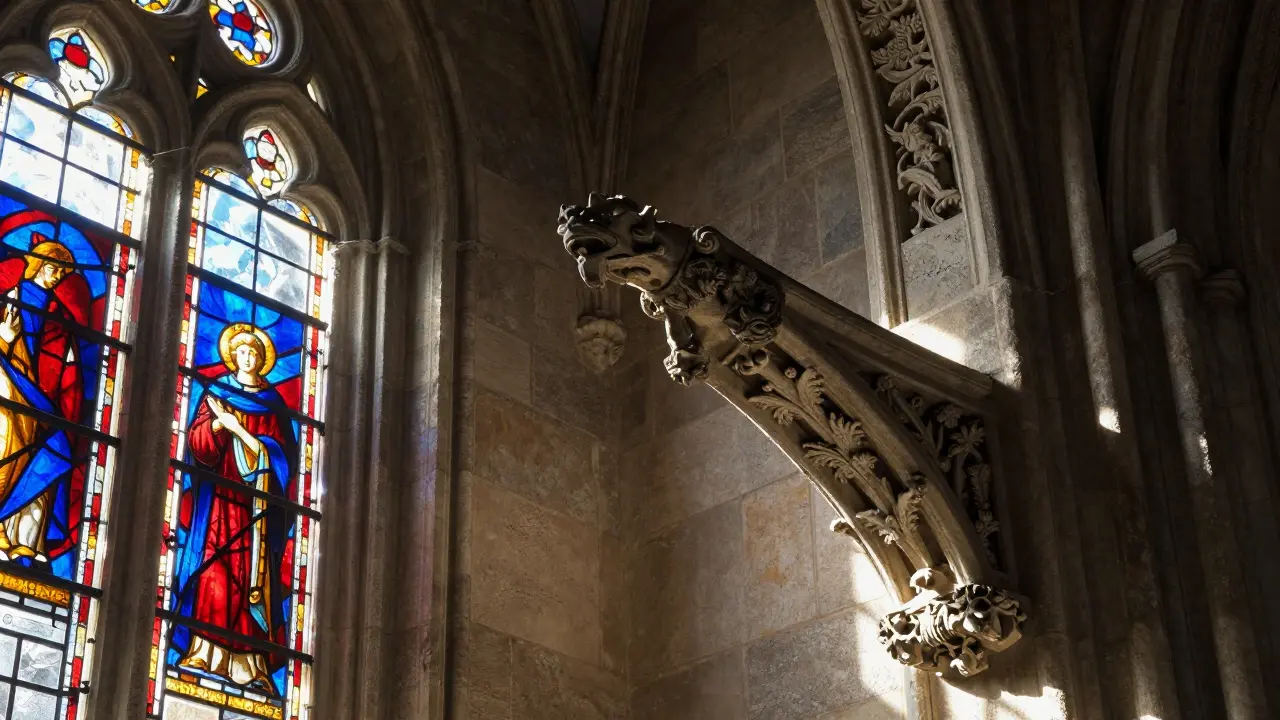
Consider the concept of *horror vacui*, the fear of empty space. Neoclassical design loved negative space. It wanted breathing room. Gothic design hated it. Look at a Gothic cathedral interior. Every inch is covered in sculpture, stained glass, and intricate stone carvings. It feels crowded, intense, and alive. This visual density mirrored the Romantic belief that truth was found in complexity, not simplicity. Artists began to see the "messiness" of nature as more honest than the polished lies of classical geometry.
The Writers Who Built the Movement
You can’t talk about the Gothic revival without mentioning the literature that fueled it. Before architects started building Gothic houses again, writers were dreaming them into existence. Horace Walpole, an English author who wrote The Castle of Otranto in 1764, is often credited with starting the Gothic literary tradition. He described his own home, Strawberry Hill House, as a place where he could live inside a medieval fantasy. It wasn’t a ruin; it was a living, breathing interpretation of the past.
Then came the poets. Lord Byron, the quintessential Romantic hero, embodied the dark, brooding spirit of the age. His characters were flawed, passionate, and often destructive-traits that resonated far more with readers than the stoic heroes of classical epics. Later, Edgar Allan Poe, though American, carried this torch by exploring the psychological depths of fear and madness. These writers convinced their audiences that the medieval past was not a dark age of ignorance, but a golden age of spiritual intensity and individual expression.
Ruskin’s Moral Crusade
If literature provided the mood, John Ruskin, a leading English art critic of the Victorian era, provided the intellectual ammunition. In his seminal work, The Stones of Venice (1851-1853), Ruskin argued that Gothic architecture was morally superior to classical architecture. He claimed that classical buildings represented slavery because they required workers to follow strict, repetitive patterns. Gothic buildings, however, allowed for freedom. The stonemason could carve leaves differently each time. He could express his individual soul in the work.
Ruskin’s argument was radical. He linked style to social justice. He believed that the "savageness" and "changefulness" of Gothic art reflected the true nature of humanity. For Ruskin, choosing Gothic wasn’t just about taste; it was a political statement against the dehumanizing effects of industrialization and rigid social hierarchies. This shifted the debate from aesthetics to ethics. Suddenly, loving Gothic art meant you cared about the dignity of the worker.
Architecture as Emotional Landscape
This philosophical shift changed how buildings were designed. Architects stopped trying to copy specific medieval blueprints and started capturing the "spirit" of the Gothic. Augustus Pugin, a British architect and designer, became a key figure in this transition. He argued that Gothic was the only truly Christian form of architecture, contrasting it with the pagan roots of classical styles. His work on the Houses of Parliament in London (along with Charles Barry) demonstrated that Gothic could be scaled up to meet modern needs while retaining its medieval character.
The result was a new kind of landscape. Country houses featured turrets and battlements not for defense, but for drama. Churches used pointed arches to draw the eye upward toward heaven. Even furniture followed these lines. Chairs had high, carved backs. Tables had claw feet. The goal was to create environments that stirred the imagination rather than calming the mind with symmetry.
Visual Arts: Shadows and Light
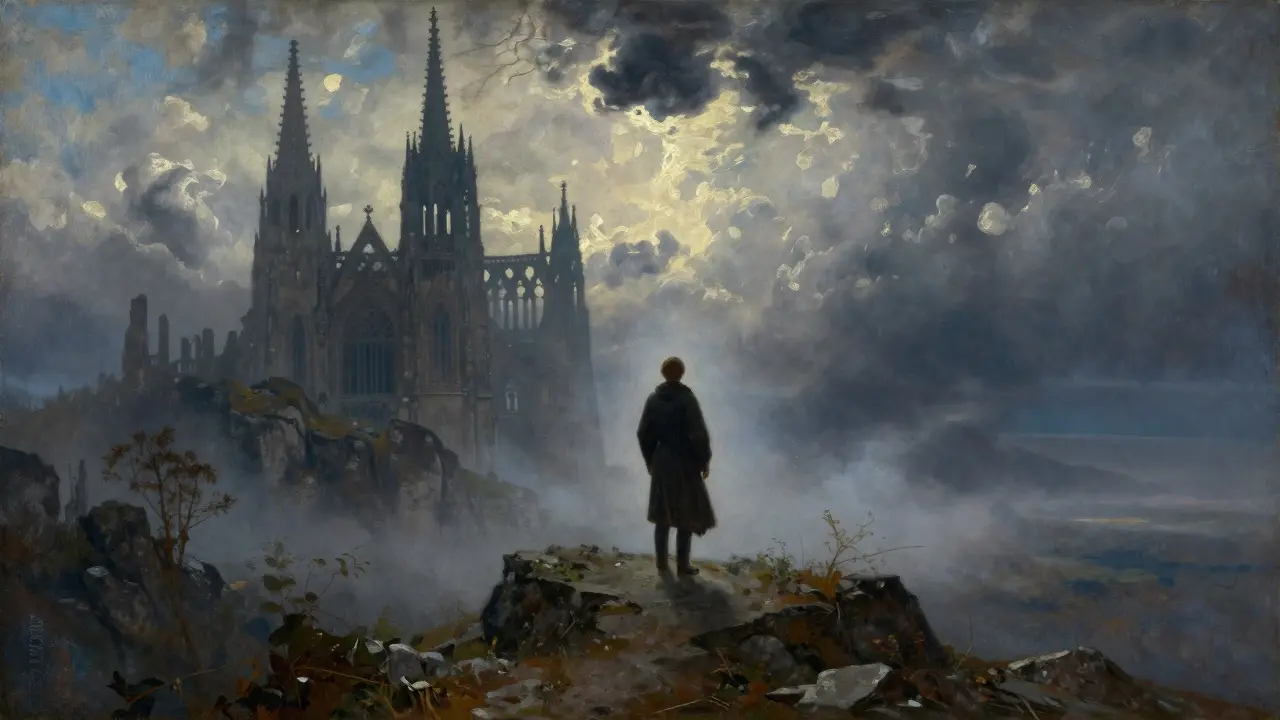
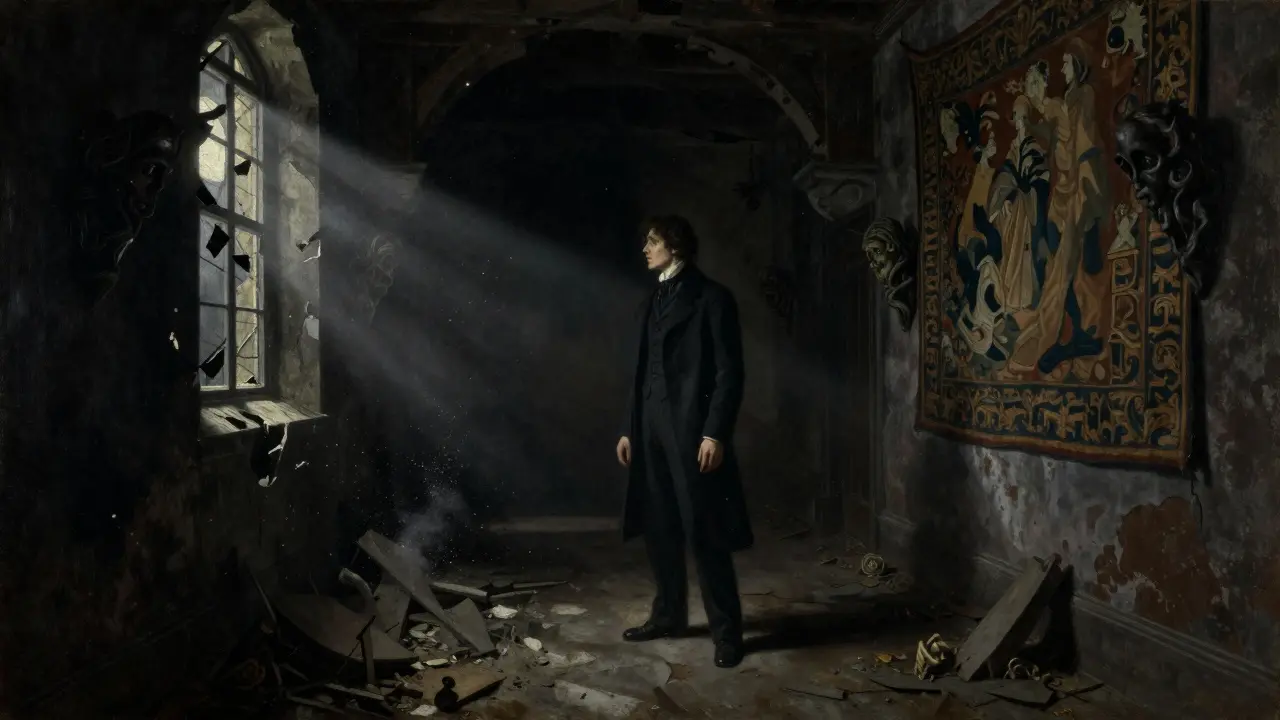
In painting, the rebellion against classicism manifested in dramatic lighting and turbulent subjects. Caspar David Friedrich, a German Romantic painter, mastered the use of solitude and nature to evoke spiritual contemplation. His figures often stand with their backs to the viewer, gazing out at misty mountains or moonlit ruins. There is no clear narrative, no heroic action. Just a feeling of smallness in the face of the infinite. This was the opposite of the clear, well-lit historical scenes favored by Neoclassicists.
Francisco Goya, a Spanish painter, pushed this even further into darkness. His later works, known as the "Black Paintings," depicted nightmares, demons, and old women in shadowy corners. These images rejected the idealized beauty of the classical tradition entirely. Instead, they confronted the viewer with the ugly, irrational sides of human existence. Goya showed that art could be a mirror to the psyche, not just a window to an idealized past.
| Feature | Neoclassicism | Gothic Revival / Romanticism |
|---|---|---|
| Ideal Source | Ancient Greece and Rome | Medieval Europe |
| Core Value | Reason and Logic | Emotion and Imagination |
| Structure | Symmetrical, Horizontal | Asymmetrical, Vertical |
| Lighting | Bright, Clear, Even | Dramatic, Contrasty, Stained Glass |
| Human Role | Citizen of the State | Individual Soul |
| Nature View | Landscape as Garden (Controlled) | Nature as Wild (Untamed) |
The Legacy of the Rebellion
The impact of this rebellion extends far beyond the 19th century. The idea that art should express inner emotion rather than outer reality paved the way for Modernism. When you look at the expressive brushstrokes of Van Gogh or the fragmented forms of Cubism, you can trace a line back to those Romantics who rejected the perfect circle for the jagged rock.
Today, we still see the tension between these two forces. We build sleek, glass skyscrapers that celebrate technology and efficiency (the Neoclassical impulse). But we also preserve old cathedrals and visit haunted castles because we crave connection to something older and deeper (the Gothic impulse). The Gothic revival taught us that there is value in imperfection, mystery, and the shadows. It reminded us that being human means embracing both the light and the dark.
Why did Romantics prefer Gothic over Classical art?
Romantics preferred Gothic art because it emphasized emotion, individualism, and the sublime, which contrasted sharply with the rationality, order, and universalism of Classical art. They saw Gothic structures as more authentic expressions of human spirituality and nature's wildness.
What role did John Ruskin play in the Gothic revival?
John Ruskin argued that Gothic architecture was morally superior because it allowed artisans creative freedom, unlike the rigid constraints of classical styles. His writings linked the Gothic style to social justice and the dignity of labor, influencing architects and designers significantly.
How does Gothic art differ from Neoclassicism in structure?
Gothic art features verticality, asymmetry, and complex details like pointed arches and flying buttresses, aiming to evoke awe and mystery. Neoclassicism relies on horizontal balance, symmetry, and simple geometric forms derived from ancient Greek and Roman models, aiming for clarity and rationality.
Who are some key figures in the Gothic literary movement?
Key figures include Horace Walpole, who wrote the first Gothic novel; Lord Byron, whose poetry embodied the dark romantic hero; and Edgar Allan Poe, who explored psychological horror. These writers helped shape the cultural perception of the Gothic as a source of emotional depth.
Is Gothic art still relevant today?
Yes, Gothic art remains relevant in its influence on modern aesthetics, particularly in architecture, fashion, and film. Its emphasis on individual expression and the acceptance of darkness and complexity continues to resonate in contemporary culture, offering a counterpoint to minimalist and purely functional designs.