
Look at your smartphone. Notice its flat screen, lack of ornamentation, and intuitive layout. Now look at a standard office chair or a minimalist apartment building. You are living inside the legacy of a school that existed for only fourteen years but reshaped how we see, build, and use almost everything around us. This is Bauhaus, the radical German art school founded in 1919 that decided beauty shouldn't be reserved for the elite. Instead, it argued that good design should be accessible, functional, and affordable for everyone.
The movement didn't just change aesthetics; it changed the logic of creation. Before Bauhaus, objects were often decorated heavily, with form following tradition rather than function. Bauhaus flipped this script. It merged fine arts with crafts, technology, and industry. The result was a visual language so powerful that it became the global standard for modernism. If you want to understand why the world looks the way it does today, you have to understand the lessons taught in Weimar, Dessau, and Berlin.
The Birth of a New Vision
The story begins in the aftermath of World War I. Europe was devastated, both physically and spiritually. There was a widespread desire to rebuild society from the ground up, rejecting the old hierarchies and decorative excesses of the past. Enter Walter Gropius, an architect who believed that art and technology could unite. In 1919, he established the Staatliches Bauhaus in Weimar, Germany. His manifesto declared that the ultimate goal of all artistic endeavor was the total work of art, or Gesamtkunstwerk.
Gropius didn't just want to teach painting or sculpture in isolation. He wanted to create a new guild of craftsmen, free from class distinctions between artist and artisan. The early curriculum was intense. Students started with a preliminary course, known as the Vorkurs, designed to strip away their preconceived notions of art. Here, they learned about materials, color theory, and composition through hands-on experimentation. This foundational approach ensured that every designer, whether working with wood, metal, or fabric, understood the fundamental properties of their medium.
The school moved locations twice due to political pressure. First to Dessau in 1925, where it reached its creative peak, and finally to Berlin in 1932 before being shut down by the Nazi regime in 1933. Despite its short lifespan, the Bauhaus produced a generation of designers who would spread its ideals across the globe, particularly to the United States after many faculty members fled Europe.
Core Principles: Form Follows Function
At the heart of the Bauhaus philosophy was the idea that the form of an object should be directly related to its function. Ornamentation was seen as dishonest if it served no purpose. This principle, often summarized as "form follows function," dictated that every curve, line, and material choice had to justify its existence based on utility and efficiency.
Another key tenet was the unity of art, craft, and technology. Unlike previous movements that separated the intellectual artist from the manual worker, Bauhaus embraced industrial production. They didn't reject machines; they sought to master them. By designing objects that could be mass-produced without losing aesthetic quality, they aimed to make well-designed goods available to the masses. This democratization of design was revolutionary. It meant that a simple teapot or a steel chair could be both beautiful and affordable.
Simplicity and geometric purity were also central. The Bauhaus palette favored primary colors-red, blue, yellow-along with black, white, and gray. Shapes were reduced to their essentials: circles, squares, and triangles. This geometric clarity wasn't just stylistic; it reflected a belief in order, rationality, and universal harmony. The visual language was stripped of historical references, creating a timeless aesthetic that felt modern and forward-looking.
Key Figures and Their Contributions
The impact of Bauhaus cannot be attributed to a single person. It was a collective effort driven by some of the most influential artists and architects of the 20th century. Each master brought a unique perspective that enriched the school's interdisciplinary approach.
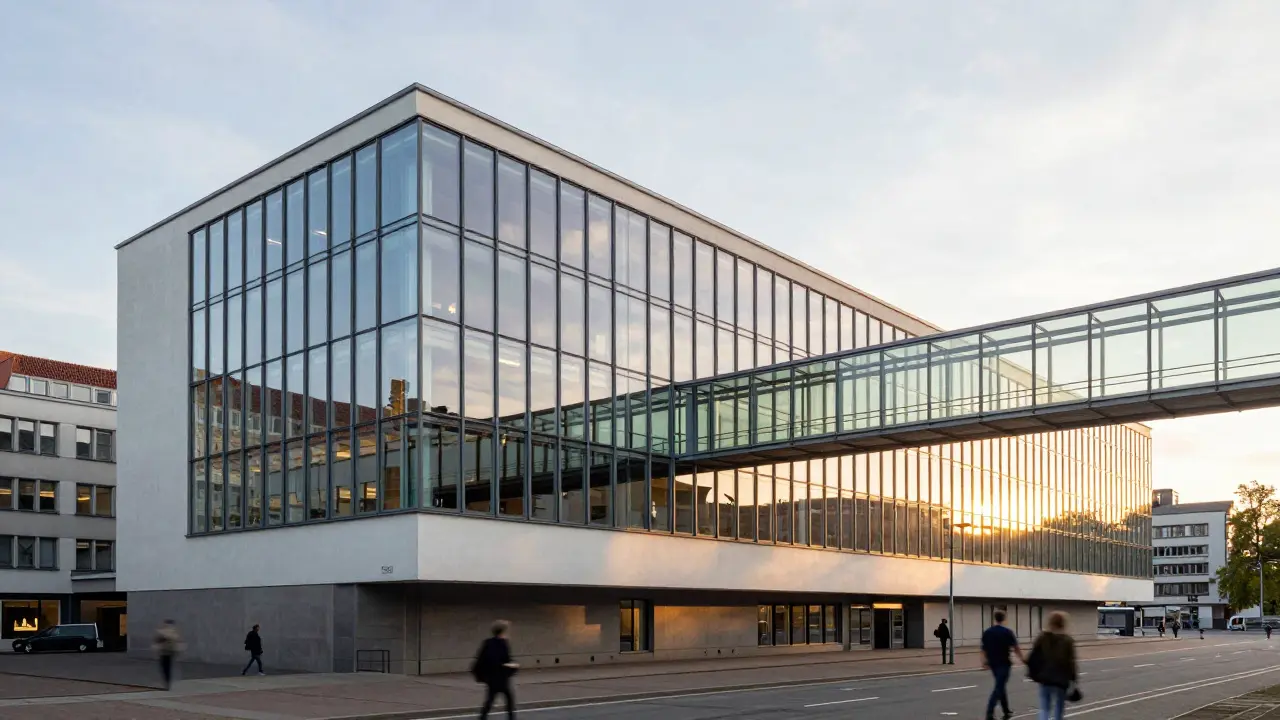
Walter Gropius laid the philosophical groundwork and designed the iconic Bauhaus building in Dessau, which stands as a testament to the school's architectural ideals. Its glass curtain walls, asymmetrical layout, and open plan redefined what a building could be. Then there was László Moholy-Nagy, who took over the preliminary course after Johannes Itten left. Moholy-Nagy emphasized light, transparency, and new materials like plastic and glass, pushing students to think beyond traditional media.
In furniture design, Marcel Breuer revolutionized seating with his Wassily Chair. Inspired by bicycle handlebars, he used tubular steel to create a lightweight, durable, and visually striking piece. This chair exemplified the Bauhaus ethos: industrial materials used in an artistic way to solve a practical problem. Meanwhile, Mies van der Rohe, the last director of the Bauhaus, distilled the style to its barest essentials. His famous phrase "less is more" became a mantra for modern architecture, emphasizing spaciousness, precision, and structural honesty.
Women played a crucial role too, despite facing gender biases. Anni Albers transformed weaving from a domestic craft into a serious art form. Her experiments with synthetic fibers and large-scale wall hangings demonstrated how textiles could influence architectural spaces. Similarly, Gunta Stölzl led the weaving workshop, developing techniques that combined artistic expression with industrial viability.
| Figure | Role/Discipline | Key Contribution |
|---|---|---|
| Walter Gropius | Founder/Architect | Established the curriculum and designed the Dessau building |
| Mies van der Rohe | Director/Architect | Refined the style with "less is more" and steel-and-glass structures |
| Marcel Breuer | Furniture Designer | Invented tubular steel furniture, notably the Wassily Chair |
| László Moholy-Nagy | Artist/Teacher | Introduced new materials and photogrammetry to the curriculum |
| Anni Albers | Weaver/Textile Artist | Elevated weaving to fine art and explored industrial textiles |

Architectural Legacy: Building for Modern Life
Architecture was the ultimate goal of the Bauhaus. While the school produced paintings, posters, and furniture, its true ambition was to shape the environment people lived in. The Bauhaus building in Dessau, completed in 1926, is perhaps the most famous example. It featured separate wings for workshops, classrooms, and student dormitories, connected by a dramatic glass bridge. The design prioritized natural light, ventilation, and efficient circulation, reflecting the needs of modern life.
This approach extended to housing projects. Bauhaus architects designed affordable apartments that maximized space and light. They introduced open-plan living areas, eliminating unnecessary walls to create flexible, airy interiors. These homes were equipped with built-in storage and modular furniture, making them easy to maintain and adapt. The focus was on creating healthy, hygienic, and efficient living environments for workers and families.
The influence of Bauhaus architecture spread rapidly. After the school closed, many of its teachers and students emigrated to other countries, bringing their ideas with them. In the United States, figures like Gropius and Mies van der Rohe helped establish the International Style, characterized by rectangular forms, flat roofs, and extensive use of glass and steel. This style dominated corporate skyscrapers and university campuses throughout the mid-20th century.
Everyday Objects: Designing for the Masses
Bauhaus didn't stop at buildings. It permeated everyday objects, from lamps and chairs to typography and packaging. The goal was to improve daily life through thoughtful design. Take the MT8 Lamp by Wilhelm Wagenfeld, for example. With its simple metal frame and frosted glass shade, it provided efficient lighting without any superfluous decoration. It was cheap to produce, easy to clean, and visually pleasing.
Typography also underwent a transformation. Bauhaus designers rejected ornate serif fonts in favor of clean, sans-serif typefaces. Herbert Bayer created the Universal typeface, which eliminated capital letters entirely, arguing that they were inefficient and outdated. This shift towards simplicity in communication mirrored the broader aesthetic goals of the movement. Clear, legible text was essential for mass communication and education.
Even playthings were redesigned. Oskar Schlemmer, a painter and stage designer, created geometric toys that encouraged children to explore spatial relationships and creativity. These toys weren't just fun; they were educational tools that aligned with the Bauhaus emphasis on learning through doing. By integrating design into play, the school recognized the importance of fostering creative thinking from a young age.

Global Influence and Modern Relevance
Today, the Bauhaus legacy is everywhere. Look at the sleek lines of Apple products, the grid-based layouts of websites, or the minimalist decor of modern homes. All of these owe a debt to the principles established in Weimar and Dessau. The movement's emphasis on functionality, simplicity, and accessibility continues to resonate in a world increasingly driven by technology and consumer culture.
In graphic design, the Swiss Style, which emerged in the 1950s, drew heavily from Bauhaus ideas. It used grids, asymmetric layouts, and sans-serif typography to create clear, objective communications. This style became the standard for corporate identity systems, ensuring consistency and professionalism across various media. Brands like IBM and Braun adopted these principles, creating identities that were both distinctive and enduring.
Education has also been influenced. Many art and design schools today incorporate elements of the Bauhaus curriculum, such as preliminary courses that focus on fundamentals before specialization. The interdisciplinary approach encourages collaboration between different fields, fostering innovation and holistic thinking. This model recognizes that complex problems require diverse perspectives and skills.
Critics sometimes argue that Bauhaus design can feel cold or impersonal. However, proponents counter that its honesty and efficiency create a sense of calm and order. In a cluttered world, the clarity of Bauhaus design offers a refuge. It reminds us that good design isn't about adding more; it's about removing the unnecessary to reveal the essential.
Preserving the Heritage
The physical remnants of the Bauhaus are now protected as UNESCO World Heritage Sites. The buildings in Weimar and Dessau serve as museums and cultural centers, attracting visitors from around the world. These sites offer a tangible connection to the past, allowing people to experience the spaces where history was made. They stand as monuments to the power of ideas to transform society.
Efforts to preserve the intangible heritage of Bauhaus continue through exhibitions, publications, and academic research. Institutions like the Bauhaus University in Weimar carry on the tradition of integrating art, design, and technology. They challenge students to address contemporary issues while honoring the foundational principles of the movement. This ongoing engagement ensures that the spirit of Bauhaus remains alive and relevant.
As we face new challenges in sustainability, urbanization, and digital interaction, the lessons of Bauhaus remain pertinent. The call for ethical, functional, and inclusive design is more urgent than ever. By looking back at the innovations of the 1920s and 30s, we can find inspiration for building a better future. The Bauhaus teaches us that design is not just about aesthetics; it's about improving human life.
What is the main principle of Bauhaus design?
The core principle is that form should follow function. This means that the shape of an object should be determined by its intended purpose, avoiding unnecessary decoration. Additionally, Bauhaus emphasized the unity of art, craft, and technology, aiming to create beautiful, functional, and affordable designs for the masses.
Why was the Bauhaus school closed?
The Bauhaus was forced to close in 1933 by the Nazi regime. The Nazis viewed the school's modernist, internationalist, and avant-garde approach as "degenerate art." They opposed its rejection of traditional German values and its association with Jewish artists and leftist politics. Many faculty members fled Germany, spreading Bauhaus ideas worldwide.
How did Bauhaus influence modern architecture?
Bauhaus introduced the use of industrial materials like steel and glass, emphasizing open plans, natural light, and functional layouts. Architects like Walter Gropius and Mies van der Rohe developed the International Style, which dominated skyscraper and institutional design in the mid-20th century. Their focus on simplicity and structural honesty reshaped urban landscapes globally.
Who were the key figures in the Bauhaus movement?
Key figures include founder Walter Gropius, directors Hannes Meyer and Mies van der Rohe, and masters like László Moholy-Nagy, Marcel Breuer, Anni Albers, and Paul Klee. Each contributed uniquely, from Gropius's architectural vision to Breuer's innovative furniture designs and Albers's textile art.
Is Bauhaus still relevant today?
Yes, Bauhaus principles are deeply embedded in contemporary design. From minimalist tech products to user-friendly web interfaces, the emphasis on functionality, simplicity, and accessibility continues to guide designers. Its legacy is visible in everything from home furnishings to corporate branding, proving its enduring impact on modern life.
What is the difference between Art Deco and Bauhaus?
Art Deco is characterized by ornate decorations, bold geometric patterns, and luxurious materials, often celebrating wealth and glamour. In contrast, Bauhaus rejects ornamentation, focusing on simplicity, functionality, and industrial materials. While Art Deco is decorative, Bauhaus is utilitarian, aiming for mass production and affordability rather than exclusivity.